
What Chihiro Notices
On spirits, staircases, and other supports

The first thing Chihiro notices is not a spirit. It takes me a while to understand why.
The roadside
The first thing I notice, together with Chihiro, is not a spirit.
It is not a shrine either, not even a road.
It is a tree.
An enormous tree rising above the trimmed uniformity of the forest canopy below. Its upper branches are broken and weathered, jutting into the sky like exposed bones.
For a brief moment, the camera lingers there before drifting downward.
A moss-covered torii gate leans against the massive trunk. Small stone shrines — hokora — cluster, tumbled, at its base.
This is where the asphalt ends and a dirt path disappears into the trees.
And this where the family’s sleek Audi sedan slows down. The parents start to bicker over directions. Chihiro looks elsewhere, toward the shrines, toward something she does not understand and cannot quite stop looking at.
Years ago, when I first watched Miyazaki Hayao’s Spirited Away (Sen to Chihiro no kamikakushi, 2001), I barely registered this opening sequence.
My attention moved where the story seemed to be moving.
Toward the bathhouse.
Toward the spirits.
Now, I find myself returning and lingering beside the road instead.
What stayed beside the road
The sedan barrels ahead through the narrowing canopy, slicing through branches that scrape against the polished sides.
Chihiro grows uneasy.
Then, for a brief moment, the film offers another pause. A stone sentinel stands among the trees. Nothing dramatic happens — the figure, a dōsojin, simply watches.
The mother barely notices. The father presses forward.
Another dōsojin appears, then another. Each one glimpsed only briefly before slipping back into the forest. The road grows rougher. Eventually the car lurches to a halt.
Ahead stands another stone figure, larger than the rest. Beyond it rises an odd red structure half-hidden among the trees. “It’s just plaster,” the father declares. A facade, a curiosity — nothing worth worrying about. He steps forward immediately and so does the mother.
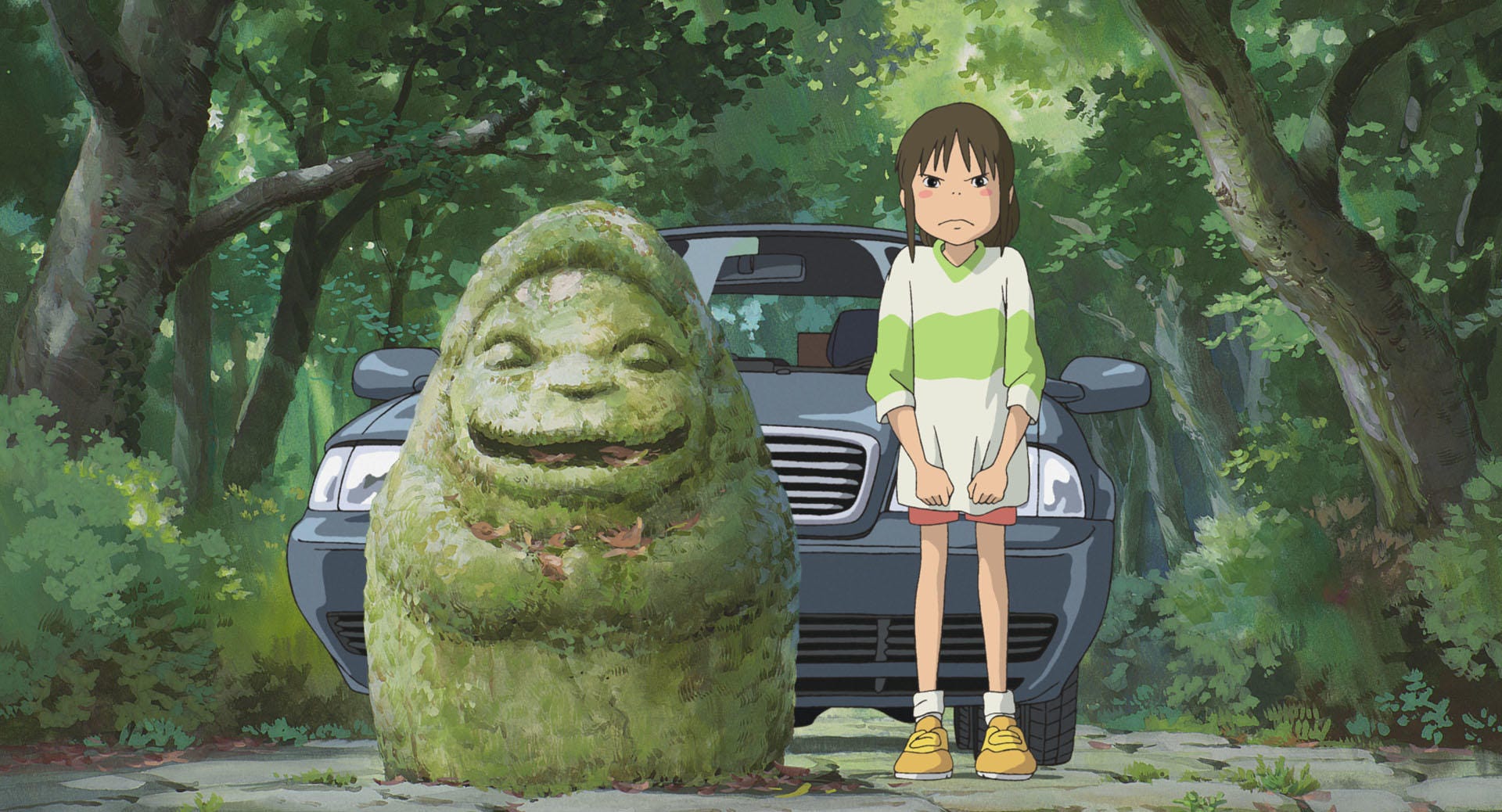
Chihiro hesitates.
The threshold feels different to her.
Then a wind arrives, lifting leaves from the ground and stirring branches overhead.
For a moment, it almost feels as though the forest itself exhales. It does not issue a command nor a warning.
It simply gathers Chihiro into its movement.
And so she follows, through the tunnel, toward a place that appears, unexpectedly, less like another world than an abandoned piece of infrastructure waiting quietly out of the spotlight.
Old benches.
Dust suspended in filtered light.
Water trickling from a rusty drinking fountain.
The remains of a station.
As though the spirits, before becoming spirits, once had travelled by train.
༄
This return surprised me.
For years, I had been speaking and writing about Miyazaki in very different ways. I had understood these scenes in much the same way many viewers do — the atmospheric prelude to the film’s real story.
The spirits were elsewhere.
The adventure lay ahead.
Recently, however, I have begun wondering whether something else is happening here. Whether Miyazaki’s most consequential gestures are often hidden inside the supports that make the story possible.
This realization arrived slowly.
After leaving full-time academia, I spent several years experimenting with different educational and therapeutic spaces. Miyazaki often travelled with me into those settings.
His films seemed to offer precisely what many participants were seeking: ecological connection, animistic imagination, alternative relationships with the other-than-human world, stories capable of nourishing hope amidst ecological uncertainty.
Over and over, I found myself speaking about healing, about enchantment, about the possibilities of recovering affects that modern life often renders difficult.
None of this felt untrue.
And yet, a subtle discomfort kept returning.
Whenever I lingered with aspects of the films that felt stranger, less consoling, less easily woven into narratives of restoration, the atmosphere in the room would often shift. The conversation would tighten, or attention would drift — something in the collective field seemed to prefer other pathways.
Healing over uncertainty.
Meaning over ambiguity.
Innocence over bewilderment.
The pattern was gentle rather than coercive. Most of the time I barely noticed it.
Only later did I begin wondering whether these preferences were shaping not only how audiences encountered Miyazaki, but also how I was learning to speak about his work.
Perhaps we were all travelling toward the bathhouse, or toward the spirits.
Toward the parts of the films that could be most easily recognized, shared, translated, and carried home.
Meanwhile, the roadside shrines and the stone sentinels remained where they had always been.
༄
What is Chihiro noticing there?
Certainly not folklore, nor mythology, nor religion, nor history.
The film gives her none of the interpretive tools that would allow her to identify the stone figures gathering beside the road.
And yet her attention continues returning to them.
I find this increasingly difficult to ignore.
The roadside presences seem to exert a kind of gravitational pull. Not because they reveal hidden knowledge, but because they interrupt the smoothness with which everyone else moves through the landscape.
The father sees a shortcut.
The mother sees an annoying detour.
The forest becomes something to drive through.
The red building becomes a facade.
The tunnel becomes an abandoned structure.
Everything is immediately incorporated into an existing map. Nothing requires recalibration.
But Chihiro’s attention moves differently.
She does not understand what she is seeing. Still, she hesitates.
At first, I wondered whether her hesitation marked a special sensitivity to spirits. Now, I am not so sure.
What follows after the tunnel feels stranger than that. The film does not reward hesitation with revelation.
It introduces conditions.
What appears when supports show
“Eat.”
Haku presses a rice ball into her hands and insists she gets it down, or otherwise she will fade.
Soon after, another instruction arrives.
“Work.”
The spirits Chihiro encounters are not hovering above material conditions. They move through elaborate systems of maintenance and circulation.
Bathwater flows through pipes.
Coal feeds a furnace.
Heat is generated.
Elevators rise and descend.
Contracts are signed.
Meals are prepared.
Rooms are cleaned.
The world remains animated, yet nobody escapes infrastructure.
For years, I tended to notice different things in these scenes: the enchantment, the spirits, the ecological wisdom. Now I find myself increasingly drawn toward the supports.
The strange insistence that beings remain present to one another only through ongoing labour.
Frog attendants move between floors carrying messages and tokens. Susuwatari soot sprites haul coal toward a furnace operated by Kamajī, the spider-like boiler man who regulates the circulation of heat and water through an intricate network of pipes. Visitors arrive as polluted river spirits and exhausted deities. Consumption swells into the hungry form of a mysterious drifter, No-Face.
Yet, the more time I spent inside the bathhouse, the less interested I became in the question of what these spirits represent.
Another question began to emerge instead. Why do they appear here?
Many readings approach these creatures symbolically. The soot sprites become childhood imagination. The Stink Spirit becomes environmental degradation. No-Face becomes loneliness, desire, capitalism, or any number of other allegorical possibilities.
What interests me increasingly is something more material. These beings emerge precisely where systems become difficult to ignore.
The soot sprites gather around fuel.
Kamajī works among heat.
The frog attendants move through circulation.
The river spirit arrives carrying accumulated waste.
After a while, I found myself looking less at the creatures than at what they seemed to gather around.
The same intuition had lingered with me days earlier while wandering through Kyōsai’s World. There, too, frogs balanced precariously atop bending stems, cats lounged atop improbable vehicles, octopuses traversed ropes suspended over empty space.
While the creatures themselves mattered, what lingered longest were the supports beneath them.
Tightropes.
Vines.
Boats.
Bridges.
The fragile systems carried movement from one place to another.
Time and again, my attention seemed to arrive a moment before collapse.
Balancing acts
Once I began noticing these supports, they seemed to appear everywhere.
Not only beneath the spirits, but beneath Chihiro herself.
Many discussions of Spirited Away describe the film developmentally as a coming-of-age story, and it certainly is one. Chihiro becomes more capable, more confident, more resourceful.
Yet what interests me here is the peculiar form that growth takes.
Again and again, the bathhouse redirects her away from its grand interiors and toward its exposed routes. To reach Kamajī’s boiler room, she must descend a long exterior staircase clinging precariously to the side of the building. Later, attempting to reach Haku, she inches across a narrow pipe suspended high above the water below. Elsewhere, she moves through service corridors, landings, platforms, maintenance passages hidden behind the spectacle of the bathhouse itself.
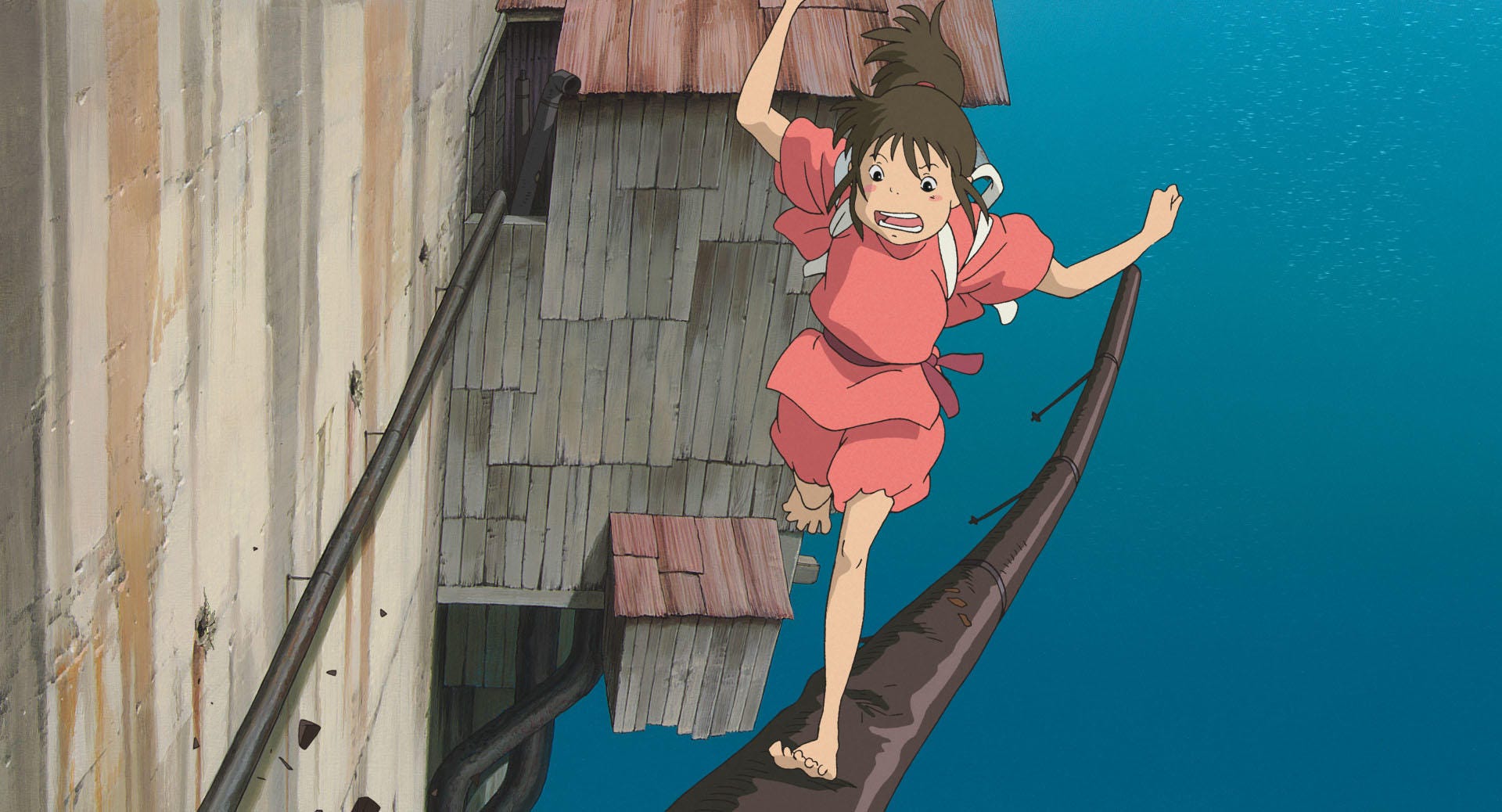
What strikes me now is how often the walls fall away in these scenes.
The building seems to open its ribs. The systems that sustain the bathhouse cease to remain hidden.
Pipes emerge from walls.
Staircases cling to facades.
Boilers pulse beneath floors.
Chihiro does not simply inhabit the spirit world. She repeatedly finds herself moving across the supports that allow it to function.
The journey is rarely upward toward revelation.
More often, it involves negotiating exposed infrastructures that have suddenly become impossible to ignore.
The sensation is strangely familiar.
I am reminded of Kyōsai’s balancing frogs, his dangling monkeys, his trembling telegraph poles. There too, movement unfolded across supports that seemed simultaneously functional and precarious.
Perhaps this is one reason both artists continue to feel so alive.
Neither allows infrastructure to disappear completely — the supports remain visible.
And visibility changes the atmosphere of the world.
The flooded tracks
Nowhere in Spirited Away do the supports become more visible than on the train.
For over two decades, the sequence lingered with an eerie force.
Like many viewers, I interpreted it afterward as atmosphere. A mindful pause, a beautiful interval before the story resumed.
間
A moment of ma.
Now I am less certain.
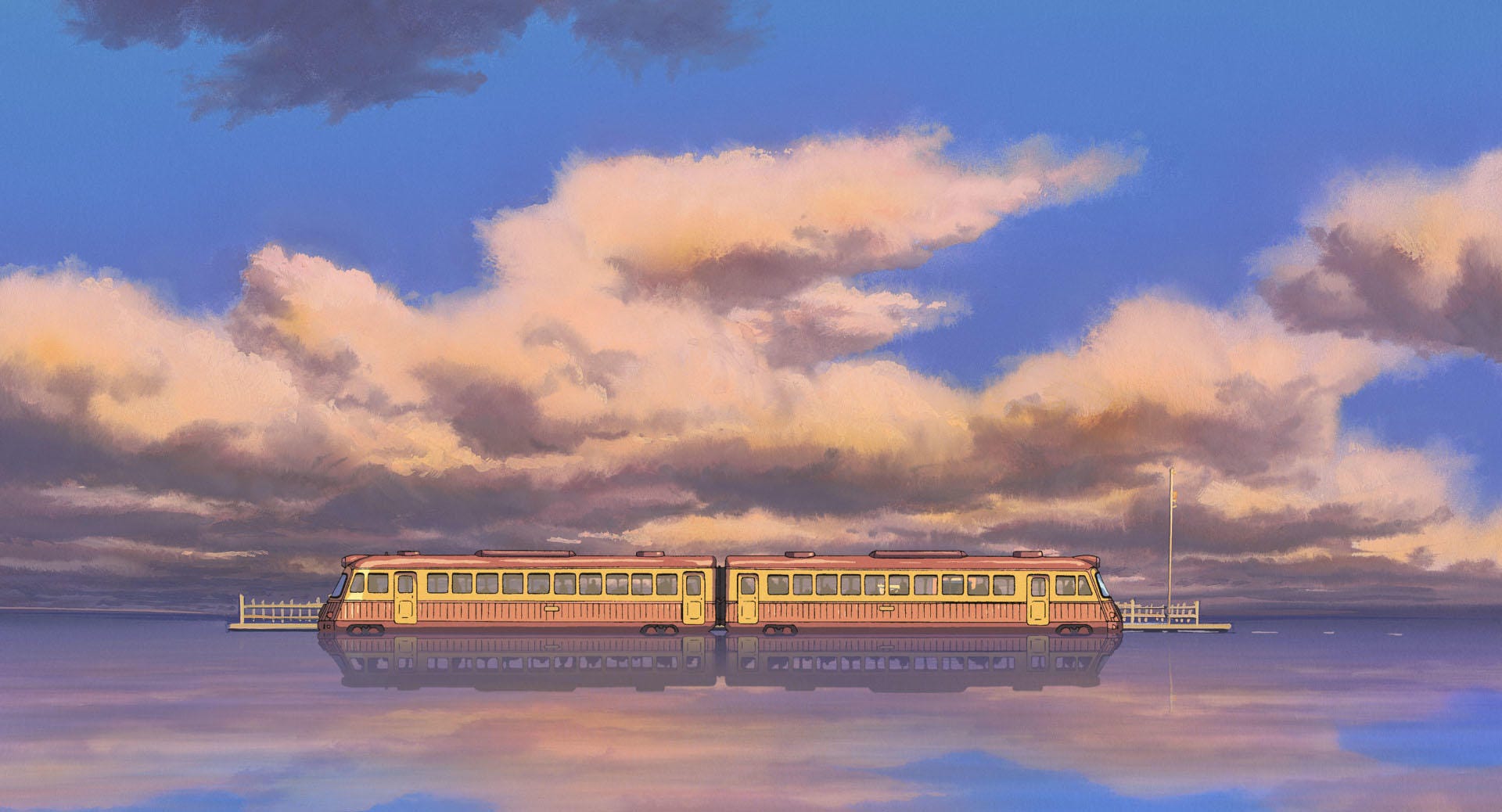
The train does not feel like an interruption. It feels like an infrastructure exposed.
The landscape has changed without explanation.
Water stretches outward in every direction.
The stations remain.
The tracks remain.
The train continues moving.
Nobody comments on this. No flood narrative appears, no ecological warning arrives, no mythic explanation is offered.
The world simply presents itself this way.
The tracks no longer seem anchored to the solid ground that once made them intelligible. Movement continues all the same.
Inside the carriage, nobody appears especially surprised.
Passengers sit quietly.
Some disembark.
Others remain.
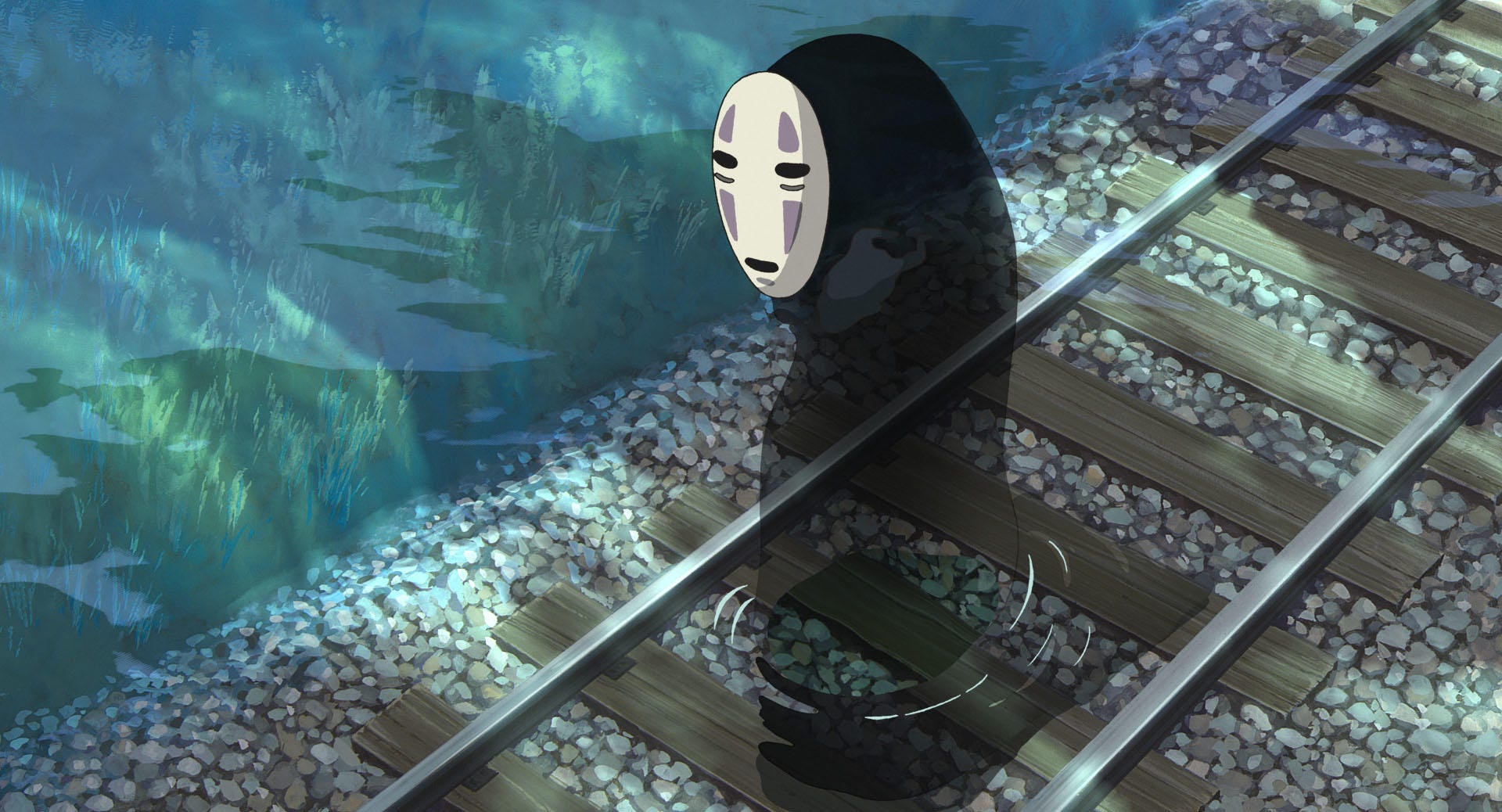
No-Face, who had once swollen into a voracious presence within the bathhouse, now sits almost impossibly still.
Nothing resolves, nothing returns.
The journey does not produce revelation.
It simply carries its passengers across a landscape where the supports have become strangely visible.
I return, once again, to Kyōsai’s telegraph poles rising through empty paper, to his cats drifting atop improbable vessels, to his frogs balancing on stems bending beneath their weight.
Here, the image feels at once different and familiar.
The tracks remain, the ground beneath them has become uncertain.
And yet the train keeps moving.
Perhaps this is why the sequence lingers.
Not because it explains anything.
But because it offers a rare image of movement after stability has ceased to organize the world completely.
Kyōsai painted during the upheavals of Meiji modernization.
Spirited Away emerged after the exuberance of Japan’s bubble years had begun to fade.
I hesitate to draw direct parallels.
Yet both artists seem unusually attentive to moments when inherited supports become newly perceptible.
Swaying telegraph poles.
Sagging tightropes.
Abandoned amusement parks.
Empty stations.
Forgotten shrines.
Bathhouses sustained through endless maintenance.
Railway lines stretching across flooded ground.
The historical circumstances remain specific to their moment.
Even so, I find myself returning to the same images.
What becomes visible when the ground beneath a system can no longer be taken entirely for granted?
༄
I return to the roadside.
The tree remains.
The torii still leans.
The small shrines gather at its roots.
Chihiro hesitates.
For a long time, I thought the story began somewhere ahead.
I am not so sure anymore.
The road ends here.
Something had already begun waiting beside it.
.𖥔 ݁ ˖🚋⋆。°•☁︎⋆˚࿔
On the difficult art of carrying worlds and subjects, materially and narratively, through periods of instability without pretending they are stable, you may also wish to visit my earlier pieces:

