
The Human Cage
On movement, exhaustion, and the thinning of enclosure

After years of containment, I am preparing to travel again.
The word does not sit easily in my mouth. It arrives with a familiarity I no longer trust.
Routes, destinations, itineraries.
These gather quickly, offering themselves as structure, as if movement could still be organized in the ways I once understood. And yet, beneath these arrangements, something else is already moving: a heaviness that does not belong to the journey ahead, but to what I am bringing with me.
Not only the practical weight of a body that has learned its limits, though that is there too, recalibrating what distance means.
Other accumulations, less easily named, are already in motion.
Histories I have moved through while mistaking proximity for understanding. Stories I have held too closely, or too lightly. Ways of seeing that once felt like attention — and now feel like intrusion.
I find myself pausing before even the smallest gesture.
Opening a map.
Booking a flight.
Imagining arrival.
Each one carries a subtle assumption: that I will go somewhere, and that something will be there to meet me.
I do not know how to inhabit that assumption anymore without noticing the work it does.
𓆨
For some time now, my dreams have been returning to the same atmosphere of precarious containment.
A stage almost collapsing into itself. Small creatures gathered behind improvised shelters. Things alive and restless pressing against structures that no longer seem capable of holding them.
What unsettles me is not really danger, but the absence of alarm. In these scenes, nothing dramatic happens. No one screams. The instability simply registers itself quietly, as if collapse had already become part of the ordinary texture of perception.
𓆨
I came upon the TikTok video while researching travel routes to Noboribetsu.
It features a tourist attraction, the “Human Cage” (hito no ori) at the Noboribetsu Bear Park (Noboribetsu kuma bokujō). Visitors descend into a small glass-walled room built inside the bear enclosure while the bears gather outside, rising on their hind legs, pressing claws and snouts against metal chutes in anticipation of treats.
The comments beneath the video move quickly between delight and unease.
“So close.”
“Terrifying.”
“Cute.”
“Look at the size of the paws.”
One bear clings to the chute with a strange, exhausted persistence. The camera lingers on the details: claws, breath, wet nose, teeth.
I watched longer than I meant to.
Something in the scene felt familiar before I understood why. For months now, a bear has been appearing in my dreams. It is neither attacking nor chasing.
It is contained.
It is barely contained behind a small wooden shed already beginning to fracture under its weight.
And always the same atmosphere: no screaming, no urgency, no dramatic revelation. Only the silent awareness that something larger than the structure holding it was already pressing through.
I had been thinking of the dream as metaphor.
Watching the video, I began to suspect it was closer to infrastructure.
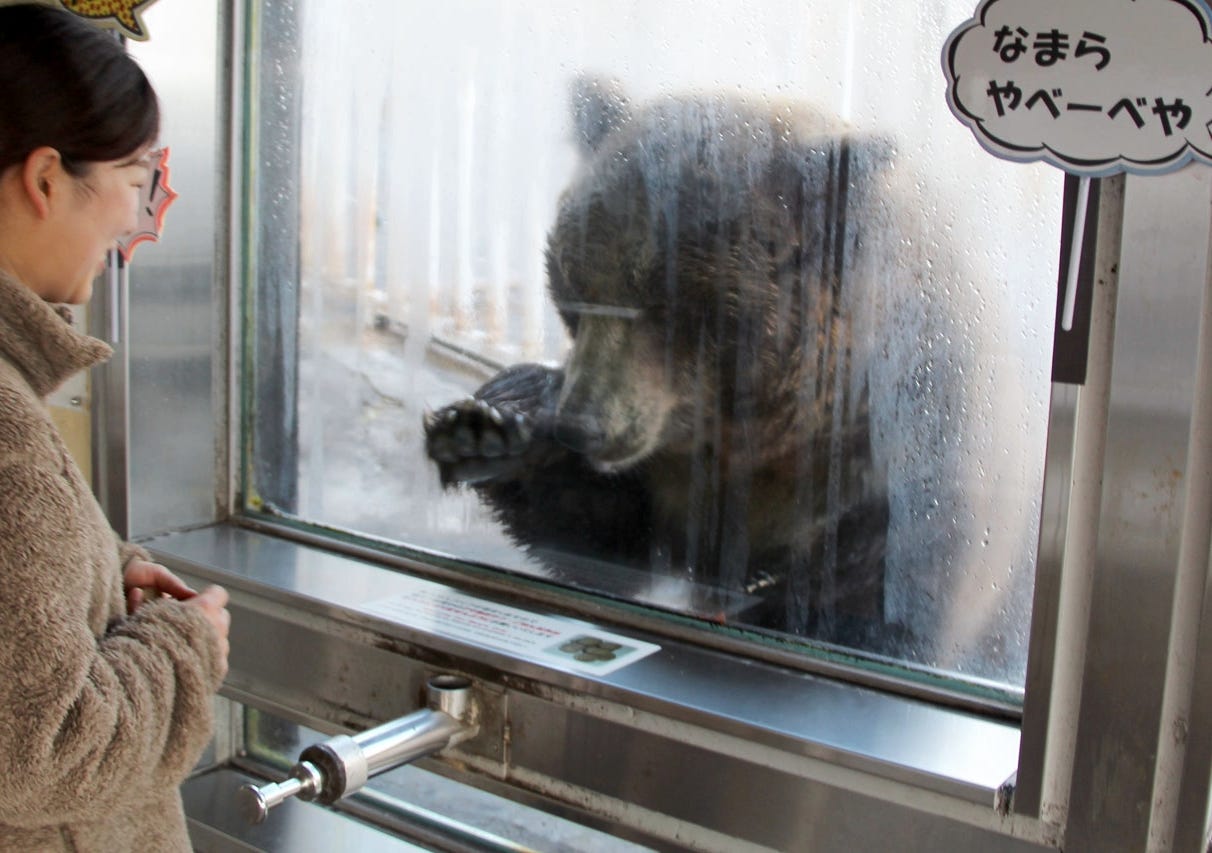
The “Human Cage” at the Bear Park was designed to produce proximity without contact.
Visitors descend into the glass chamber carrying plastic bags of food pellets sold at a vending machine on a corner. Above ground, the bears gather quickly, orienting themselves toward the small openings in the metal chutes. Paws grip the edges. Breath clouds the glass.
The exchange repeats itself with practiced efficiency: anticipation, feeding, retreat.
Watching the video, I found myself paying less attention to the bears than to the choreography surrounding them. The slow circulation of bodies through the enclosure. The framing of the camera. The delighted disbelief of the visitor encountering the animal at such intimate range while remaining untouched by it.
“So close.”
The phrase appeared repeatedly in the comments.
So close to what, I wondered.
Not to wilderness.
Not to relationship.
Perhaps only to the carefully managed sensation of proximity itself.
I realized, uneasily, that much of my own movement through Japan over the years had been organized around similar desires, though in subtler forms. Not only the desire to see, but to encounter meaningfully. To move attentively — and ethically. To approach places and stories in ways that might resist the flattening gestures of tourism or extraction.
At the time, these impulses felt different from consumption.
Now, I am less certain.
Even careful attention can become a way of securing oneself within the encounter. A way of remaining recognizable to oneself while moving through unfamiliar landscapes.
The ethical traveller.
The respectful listener.
The self-critical observer.
The structures shift, while the centrality remains strangely intact.
I feel this now each time I imagine arriving in Hokkaido.
I have already mentioned the practical uncertainties of the journey, as the ailing body negotiates fatigue.
But there is another uncertainty underneath them: the growing inability to distinguish clearly between relation and the desire to experience oneself as relational.
𓆨
In recent weeks, I have found myself returning to travel narratives I once studied closely, and to fragments of my own research from that period.
I began rereading them almost absentmindedly at first, searching for practical references, old notes on Hokkaido and the Ainu, traces of routes and encounters that now feel strangely distant from the conditions through which I move.
What drew my attention most insistently were the arrival scenes.
Again and again, the traveller reaches a threshold: a remote village, a mountain path, a train platform, a forest edge. The writing slows, the atmosphere thickens. Attention sharpens itself against unfamiliar textures.
The scene announces itself as encounter.
And often, the traveller appears acutely aware of the instability of what is taking place. There are hesitations, reflexive gestures, acknowledgements of mediation and asymmetry. The landscape is framed as resistant to easy understanding. The limits of perception are openly confessed.
For a long time, I took these moments as signs of ethical seriousness. Evidence that the writer had recognized the problem of mastery and was attempting to move differently within the encounter.
Now, reading them again, I notice something else persisting beneath the hesitation.
The traveller remains intact.
Even in uncertainty, the traveller continues to function as the gravitational center through which the instability acquires meaning. The encounter may wound, humble, or complicate the self, but the self still gathers the scene back into coherence through the very act of narrating its disturbance.
Even paralysis can become structure.
Even grief can become atmosphere.
I feel the force of this recognition most sharply when I return to my own earlier work. Beneath the academic language and the careful theoretical framing, I can now sense another impulse moving silently through the writing: the desire to approach ethically without surrendering the stability of the one who approaches.
At the time, I could not fully perceive this. Or perhaps I could, but only indirectly.
Certain images recur now with a strange familiarity. Thresholds. Forest edges. Small railway stations suspended between departure and arrival. Encounters with people, animals, stories that seemed to promise not knowledge exactly, but a more ethical form of attention.
I no longer know whether attention itself is innocent of possession.
𓆨
The journey itself has not yet begun.
No flight has been booked.
No packed suitcase is waiting by the door.
And yet Hokkaido has already started gathering around me in fragments.
A railway map opened and closed without finishing the route.
Weather reports from Asahikawa.
Photographs of the Noboribetsu River in late summer.
The sharp angles of tourist signage appearing between images of forests and volcanic steam.
The movement remains strangely suspended between anticipation and resistance.
At times, I catch myself imagining the journey too easily. The familiar narrative forms return almost automatically: the northward movement, the encounter with landscape, the slowing down before places marked by historical violence and cultural loss. I recognize how readily the imagination begins arranging these elements into atmosphere before anything has yet been lived.
The body interrupts this choreography repeatedly.
Fatigue enters first.
Then hesitation.
The quiet calculations that now accompany even modest distances: where to rest, how long to walk, what happens if the body stops cooperating far from familiar routines.
For several years, illness narrowed my world to rooms, nearby streets, weather patterns observed from windows, the small repetitions through which days became navigable again. During that time, movement itself acquired a different density. Distance no longer functioned abstractly.
Every journey carried consequence.
Perhaps this is partly why the prospect of Hokkaido unsettles me so deeply now.
It is not that the journey feels impossible. It is because I can no longer sustain the illusion that travel simply reveals the world to a coherent observer moving steadily through it.
Something else has become visible instead. The infrastructures, fantasies, and asymmetries that quietly organize the possibility of movement itself.
Who travels.
Who interprets.
Who remains available to encounter.
And beneath these questions, another one, more difficult to stabilize.
What kind of subject still imagines itself arriving?
𓆨
This summer, shortly after the academic semester ends, I will undergo a small but delicate surgery. By the time I travel north to Hokkaido in August, my body will likely still be moving through its own slow negotiations with exhaustion.
At first, I imagined the journey in familiar therapeutic terms. Noboribetsu is not only Chiri Yukie’s birthplace; it is also one of Japan’s most famous onsen towns. I pictured hot mineral water, steam rising through volcanic valleys, the quiet choreography of bathing and recovery.
And yet, when I began searching for maps of the area, my attention kept drifting elsewhere.
ひぐまっぷ。
Bear maps.
Stylized warning icons scattered across roads, forests, hiking trails, residential edges. Coloured gradients marking increased sightings, encounters, attacks. Municipal advisories layered over tourist infrastructure.
I found myself following the lines almost compulsively.
Boundaries.
Settlements.
Movement corridors.
The longer I looked, the more something beneath the maps began to register itself.
It was not information.
It was effort — continuous effort.
The immense and ongoing work required to maintain separation: between settlement and forest, human movement and animal movement, safety and threat, leisure and survival.
I could almost hear it, the low mechanical hum of maintenance.
Road crews.
Warning systems.
Hunters.
Barriers.
Tourism management.
Seasonal monitoring.
Municipal labour.
The endless infrastructural work of keeping worlds arranged in stable relation to one another.
And then, increasingly, the hum began to falter.
News reports spoke repeatedly of “the bear crisis.” But what caught my attention was another phrase buried within them:
“Exhaustion on the ground is reaching its limit.”
The sentence landed with unusual force.
Not only exhausted residents.
Not only exhausted hunters and municipal workers.
Exhausted roads.
Exhausted forests.
Exhausted maintenance systems.
Exhausted nervous systems.
It began to feel as though the enclosures themselves — the energetic and material membranes that had long kept these worlds apart through continuous colonial and infrastructural labour — were fraying under accumulated strain.
And through these thinning seams, something was moving.
It wasn’t “nature returning.” Neither was it the romantic reappearance of “the wild.” It was something less symbolic, less available to narrative.
A living field exceeding the distinctions that had organized it.
The bears were not arriving from elsewhere.
Perhaps the separations themselves were becoming harder to maintain.
𓆨
In earlier years, I moved through these materials differently.
Archives, translations, literary histories, movements and communities, museum exhibitions — these felt, if not transparent, then at least navigable. They formed the necessary pathways through which figures like Chiri Yukie could be approached, studied, taught, written about.
I rarely questioned the stability of those pathways themselves.
Now, they appear differently to me.
I don’t see them as false or malicious.
I see them as effortful.
I begin noticing the immense labour required to render certain lives and voices available within recognizable literary and academic forms.
The work of translation, annotation, editorship, preservation, contextualization, display.
The work of making encounter possible.
And beneath that, a subtler movement: the gradual organization of living relations into forms that can circulate safely through institutions, classrooms, museums, essays, books.
I do not mean this as accusation. I still rely on these structures. Without them, I would not even know Yukie’s name.
Still, something in my relation to them has become less secure. As though the enclosures through which Yukie once appeared legible to me are no longer fully containing what exceeds them.
Or perhaps it is my confidence in those enclosures that has begun to fray.
𓆨
The journey still has not happened.
As I write this, the travel routes remain open on my screen beside weather reports and bear advisories. Small icons scattered across the map continue marking recent sightings near roads, forests, settlements.
The boundaries remain visible, though less stable than before. I no longer imagine the journey as encounter in the way I once might have.
Nor the journey as revelation.
Nor the journey as healing.
Even the journey as understanding is beginning to falter.
And yet I continue preparing to go.
This feels difficult to explain without falling back into familiar narrative shapes: the wounded traveller seeking transformation, the careful observer attempting to move carefully through damaged histories, the body searching for restoration in landscapes already overburdened by other forms of exhaustion.
Perhaps what unsettles me most is that none of these narratives have disappeared entirely.
They still move through me.
The desire for meaningful encounter.
The longing to listen well.
The impulse to gather experience into language before it disperses.
While I do not stand outside these movements, they no longer feel fully intact.
Something in the structures that once organized travel, writing, and relation has begun to loosen under pressure. They are not collapsing completely nor vanishing. But they are fraying enough for other presences to become perceptible: the labour of maintenance, the exhaustion beneath infrastructure, the instability of the enclosures themselves.
The bears crossing settlement edges.
The thinning authority of maps.
The fatigued body recalculating distance.
The uneasy persistence of stories that no longer settle cleanly into meaning.
I think of the glass chamber at the bear park again.
The human cage.
The visitors descending carefully underground while the bears gather above them. At first, the enclosure appears to clarify positions: observer and observed, inside and outside, safety and danger.
But the longer I sit with the image, the less stable those distinctions become.
Perhaps this is what remains when return no longer functions as resolution, or innocence, or withdrawal-as-mastery through self-critique.
Only the ongoing work of moving through compromised relations without allowing them to harden too quickly into narrative certainty.
The travel routes continue north.
Somewhere beyond the maps and warning systems, beyond the tourist itineraries and archival enclosures, bears are still moving through exhausted forests that do not belong to my understanding.
Soon, I will begin moving too.
𓆨
🐻 For those wishing to go deeper into the infrastructural and eco-narrative entanglements of bears, my piece On Bears, Ghosts, and the Unravelling of Relationship in Japan’s Forests sits with what it means to hesitate before naming and shooting.
🧳 Some of my earlier research on travel writing is available outside of paywalls on my Academia webpage:
“‘I write the truth as I see it’: Unsettling the Boundaries of Gender, Travel Writing and Ethnography in Isabella Bird’s Unbeaten Tracks in Japan” (2013)
I love this piece. And I shudder at the imagery of the “encounter” with the bears. It’s painful to even imagine! And… I didn’t know about your physical health challenges. Blessings on the upcoming surgery. And blessings on the travels, with all that is present…
Someone once told me... move the body and the brain will follow!