
Invisible Transmissions
On fog, yōkai, and trembling infrastructures in Kyōsai’s World

Entering through fog
The afternoon I visited the Kyōsai exhibition, the city was wrapped in fog.
Somewhere between the metro station and Tokyo Midtown, Izumi Kyōka’s phrase began quietly surfacing through the fog.
たそがれの味。
The taste of twilight.
Kyōka wrote of twilight as a world entered in passing, a fleeting interval suspended between day and night, light and darkness, where perception loosens from the stability of categories and moves through subtler shades difficult to hold in language.
That afternoon, Tokyo itself seemed to drift toward such a threshold world.
Buildings dissolved into gradients before reappearing elsewhere through the haze.
Distances thickened and thinned unpredictably.
Glass towers hovered above the fog like engine cylinders suspended in pale air.
Inside the vast shopping complex called Galleria, the sensation deepened. Warm wooden tones, softened lighting, carefully arranged high-end storefronts — surfaces flowed together with such seamless continuity that orientation gradually became difficult to maintain. Corridors opened into other corridors. Escalators carried bodies soundlessly upward through the building’s interior layers. Time itself seemed briefly suspended inside the softly glowing structure.
Somewhere within that movement, a low atmospheric unease began gathering beneath the smoothness.
The museum of smooth surfaces
The entrance to the Suntory Museum of Art appeared so seamlessly integrated into the surrounding commercial architecture that I walked past it more than once before realizing I had already arrived.
Perhaps this was partly why the disorientation inside Galleria lingered.
The museum did not emerge through interruption or threshold. It unfolded gradually from within the same atmospheric field as the luxury boutiques surrounding it: warm wooden slats, softly illuminated interiors, polished stone surfaces, carefully modulated stillness.
Culture, retail, circulation, and aesthetic contemplation flowed together without friction.
Just outside the elevator leading visitors toward the exhibition galleries, a charming “photo spot” awaited. A giant nekomata — a cat yōkai — cutout against a soft indigo backdrop announcing Kyōsai’s World. Nearby, the nekomata’s head protruded from the wall on a small coil spring mounted on a wooden support, bobbing gently whenever visitors touched it.
Inside the museum shop, the same cat reappeared endlessly on stationery, tote bags, keychains, plushies, postcards, soft merchandise arranged beneath carefully calibrated lighting.
The yōkai were already circulating before the exhibition itself began.
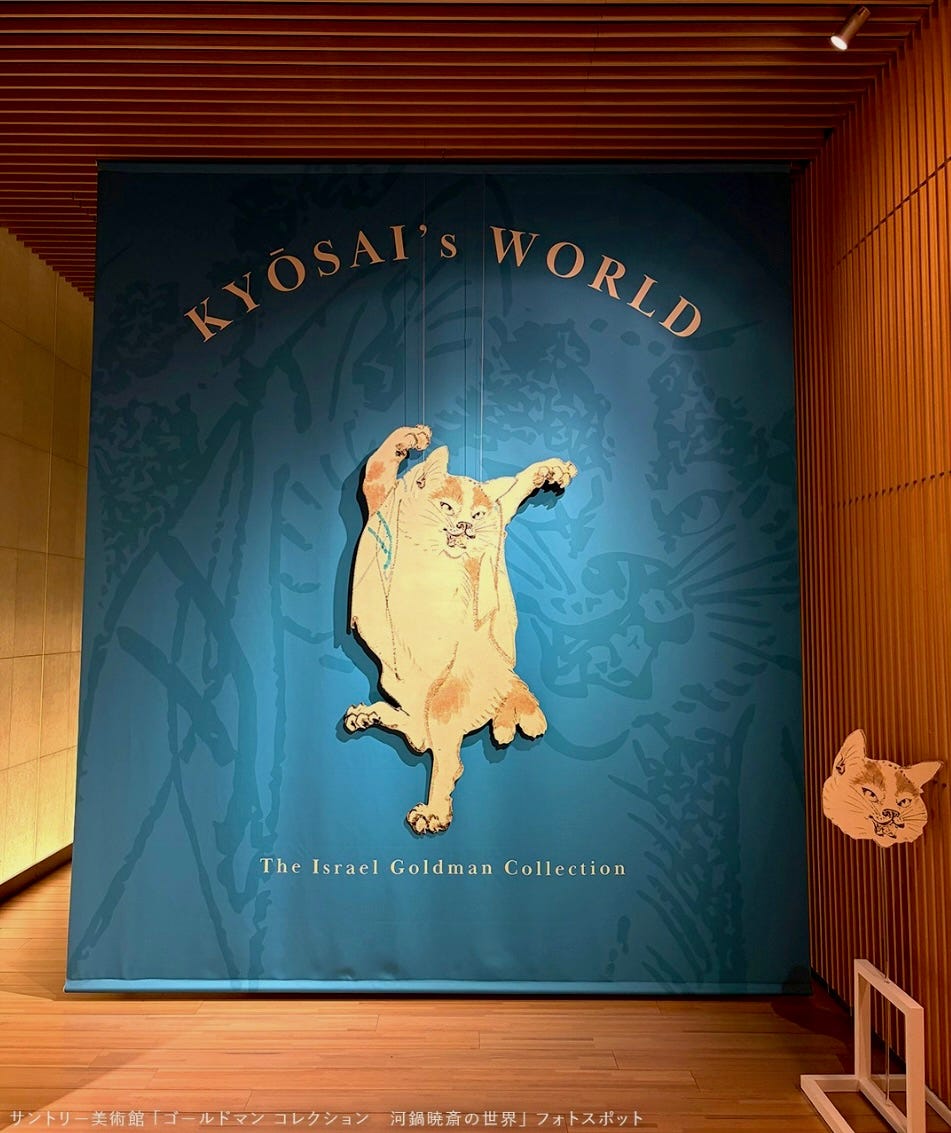
Something about this felt strangely fitting for Kawanabe Kyōsai (1831-1889). His worlds, too, teem with creatures moving between registers: comic and unsettling, playful and uncanny, folkloric and commercial, improvised and theatrical.
Still, standing before the bouncing nekomata head, I lingered uneasily at another threshold altogether — the transformation of transitional beings into infinitely reproducible atmospheric companions for contemporary circulation systems.
Not only museum systems, but increasingly platform systems as well. Photographable presences, mascot presences, softened presences moving frictionlessly through visibility infrastructures.
Upstairs, the exhibition galleries unfolded in calibrated darkness.
Floating glass vitrines emerged geometrically from the dim space beneath slatted wooden ceilings. Pools of directed light illuminated hanging scrolls and painted surfaces while concealing almost everything involved in maintaining the environment itself:
Climate systems.
Security systems.
Cleaning systems.
Installation labour.
Transport labour.
Institutional labour.
The space felt curiously stage-like.
Not theatrical in any flamboyant sense. More like a carefully controlled perceptual apparatus organized to smooth encounter and minimize friction around the objects on display.
The thematic sequencing of the display reinforced this sensation:
Beasts.
People.
Demons.
The Divine.
The captions worked diligently to orient visitors through iconographic references and symbolic explanation. The exhibition catalogue — visually exquisite and scholarly meticulous — extended the same stabilizing gesture. Everywhere, interpretive pathways appeared gently prepared in advance.
And yet, the paintings themselves repeatedly slipped sideways from those frameworks. Inside the carefully stabilized galleries, forms of life balanced precariously atop tottering structures.
The exhibition space concealed its supports with extraordinary precision.
Kyōsai’s worlds exposed theirs.
Balancing acts
After some time, the thematic sequencing of the exhibition began loosening its grip on my attention. The paintings themselves began gathering into different constellations.
I wouldn’t call them motifs.
Something more infrastructural seemed to pulse faintly across the glassed galleries.
Again and again, animal bodies appeared suspended upon unstable supports. Frogs balanced atop thin plant stems bending under their weight. Monkeys dangled from vines before rushing waterfalls. Bats and octopuses traversed sagging tightropes, climbed ladders, performed acrobatic feats high above wide fields of emptiness.
Even the quieter paintings retained this sensation of suspension.
A cat reclined elegantly on top of a giant catfish boat while smaller cats strained forward pulling it by the whiskers beneath the faint silhouette of a bridge. Elsewhere, frogs passed beside a swaying telegraph pole that looked less an emblem of technological mastery than a thin connective line suspended temporarily against a void.
The more I lingered, the more difficult it became to experience these creatures as inhabitants of stable worlds.
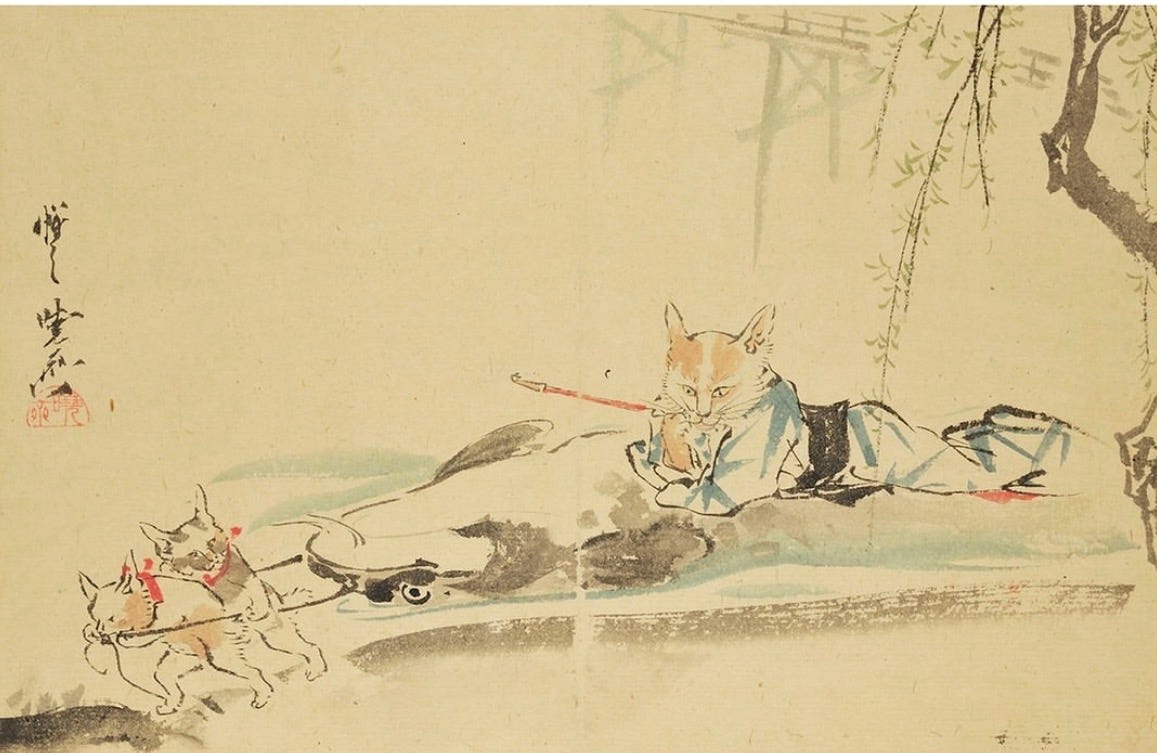
Kyōsai’s animals rarely appear fully settled into their environments. They balance, traverse, cling, perform, drift. They improvise their way across transitional systems whose supporting structures never fully solidify.
The balancing itself seems to become, at times, the subject of the work.
What fascinated me most was the tonal atmosphere surrounding these scenes. The paintings never hardened into straightforward satire or allegory.
Their instability remained more atmospheric than moral.
Humour and unease circulated together without resolving into critique or consolation.
The frogs continue balancing with admirable composure.
The monkeys continue dangling with consummate aplomb.
The cats continue smoking calmly atop improbable arrangements.
Everywhere, movement persists across structures that appear nearly incapable of holding the worlds organized around them.
At moments, the exhibition itself began quietly echoing the paintings surrounding it.
Escalators carried visitors soundlessly between floors. Bodies drifted through dimly illuminated galleries organized by invisible systems of climate control, architectural flow, institutional maintenance, and commercial circulation. Wooden surfaces glowed softly beneath carefully modulated light.
The infrastructural supports remained mostly concealed, even as they shaped every aspect of perception within the building.
Kyōsai’s paintings seemed to move differently. Their supports wobble and totter. Telegraph poles lean uncertainly through fog-like emptiness, tightropes sag, vines twist, stems bend beneath accumulated weight.
Modernity had not yet solidified into inevitability there.
Its infrastructures still trembled visibly.
Telegraph poles in the fog
I keep returning to the telegraph pole.
Compared to the crowded acrobatic scenes elsewhere in the exhibition, the painting itself now appears strangely sparse. The frogs look awkward as they pass across the lower portion of the image inside a lotus rickshaw while, above them, the thin telegraph pole rises uncertainly through a vast horizontal field of unoccupied paper.
The emptiness surrounding the pole exerts its own pressure.
Rather than appearing monumental or triumphant, the infrastructure feels provisional — a fragile vertical line suspended temporarily against an expanse that threatens to swallow it back into atmospheric indistinction.
The pole seems almost too delicate to organize the world gathering around it. Still, it remains there, thinly connecting distant points through invisible transmissions.
Perhaps this is part of what makes the image linger with such force.
The painting does not present modern infrastructure as stable achievement. It registers something far more unsettled: a world learning to move among emerging systems whose perceptual and atmospheric consequences have not yet fully hardened into familiarity.
I realize how, elsewhere throughout the exhibition, similar sensations had surfaced repeatedly.
Bridges appeared faintly in the distance before dissolving into mist-like washes of ink. Animals improvised their way across sagging supports, dangling vines, unstable transport systems, and swaying stems. Telegraph poles, ladders, tightropes, whiskers, branches — the connective infrastructures themselves seemed to wobble visibly beneath accumulated movement.
There were moments when the paintings began feeling less like representations of ghosts and yōkai than atmospheres in which worlds themselves had become slightly difficult to stabilize.
And perhaps this is partly why ghosts and yōkai so often gather around periods of infrastructural transition.
And why their stories so often proliferate around thresholds:
bridges,
tunnels,
crossroads,
railways,
riverbanks,
ports,
theatres,
electrical systems,
fog,
twilight,
sites of travel and transmission.
Not outside infrastructure, but within moments when infrastructure itself becomes perceptually uncanny.
I don’t think this is because modernity simply “displaces tradition,” as institutional narratives often suggest. The perceptual worlds opening inside Kyōsai’s paintings feel stranger and less linear than such oppositions allow.
Something else trembles there.
The sensation of living among systems whose organizing logics have not yet settled into invisibility.
Trembling supports
Telegraph poles rising uncertainly through emptiness.
Bridges emerging faintly in the background before dissolving again into mist.
Animals improvising their way across unstable transport systems and dangling supports.
Movement continues, though the world itself appears slightly unsettled beneath it.
It is as if the paintings are registering worlds colliding faster than stable perceptual frameworks can fully metabolize them.
Older cosmologies.
Emerging technologies.
Urban growth.
Spectacle cultures.
New circulation systems arriving before their atmospheric consequences have settled into familiarity.
I find myself returning to Izumi Kyōka and his subtle worlds suspended between darkness and light — worlds entered not through rupture, but through gradual atmospheric drift.
The fog outside Tokyo Midtown still carries something of that sensation. High-rise towers hover above softened contours like unsupported forms suspended in pale air. Inside the Galleria mall, escalators and corridors guide bodies through seamless commercial interiors whose immense supporting systems remain almost entirely concealed beneath atmospheric smoothness.
Elsewhere, invisible infrastructures choreograph attention, visibility, circulation, and artistic survival with comparable opacity.
And perhaps this is where Kyōsai’s trembling telegraph poles begin to feel unexpectedly contemporary.
It’s not that the nineteenth century anticipated the twenty-first in any predictive sense. The historical conditions remain profoundly different. Yet, both worlds seem shaped by infrastructural transformations arriving faster than perceptual coherence can stabilize around them.
Kyōsai’s creatures continue balancing precariously inside those unstable intervals.
The balancing goes on.
𓆏
Love this! I can actually feel it in an embodied way. And I feel the emotional tone of these structures and beings - hovering, trembling, there, and yet… and the museum trying to explain, to educate, to stabilize… Thank you for this. And btw, what exactly does yokai mean?