
Exoskeletons
On animism, AI, and the forms that hold relation

Under the plum tree
On the path that used to lead to my house in rural Yamanashi, there stood a small roadside shrine under a plum tree.
It was easy to miss at first.
The stone was cracked, the roof slightly tilted, the ground around it overgrown with weeds. Someone had once cared for it, but that care had long since thinned.
One day, while clearing the foliage around the base, I noticed a moss-covered stone half buried in the soil. Carved into it were the characters 馬頭観世音菩薩 (Batō Kannon Bosatsu) — the horse-headed form of Kannon associated with animals, travellers, and the dead.
It took me some time to understand why the shrine stood there.
Long before the road became a narrow rural track, this had been part of an older route connecting the scattered mountain villages of the region. A horse must have died at this spot, perhaps suddenly, perhaps violently, and the shrine had been built to mark the event, to appease what had been disturbed, to keep the place in balance.
Nothing in the shrine explained itself.
There was no inscription telling a story, no doctrine attached to the gesture, no clear boundary between memory, fear, gratitude, or habit.
And yet, the moment I understood what might have happened there, my relation to the place changed. I began to clean the shrine, to straighten the small offerings left by someone long ago, to bow before passing.
This obligation did not come from belief.
It came from the sense that the place itself required a certain kind of attention, and that the small structure standing there made that attention possible.
In Japan, such roadside shrines — hokora — appear in the most ordinary places: at the edge of a field, beside a riverbank, near a crossroads, between houses, in the corner of a parking lot.
They do not prevent modern life from unfolding around them.
They do not demand a fully articulated theology.
They simply remain there, marking a relation whose meaning may no longer be fully known.
Only later did it occur to me that the hokora functions less like a container for a spirit than like a kind of exoskeleton — a small protective casing built around something that cannot be seen directly.
What it protects may not be a being in any clear sense. It may be memory, danger, obligation, grief, gratitude, or uncertainty.
The structure allows that invisible field to persist, even when the story that gave rise to it has been forgotten.
Living for many years in a landscape where such structures are still visible has made me cautious when I encounter contemporary attempts to describe them as quaint manifestations of a uniquely Japanese animistic sensibility.
What makes me even more cautious is the growing tendency, in Western eco-spiritual discourse, to speak of animism as if it were a coherent ontology — a final account of what the world ultimately is: relational, alive, participatory.
My hesitation does not come from disbelief.
It is not about whether these approaches are right or wrong.
It comes from the sense that what keeps relations alive is often not an overarching theory or a conceptual framework or an aesthetic, but a form that allows them to remain without needing to decide, once and for all, what they mean.
It is about how differently such gestures appear when seen from other cultural and historical ground.
What had nowhere to go
I began to notice this form more clearly after moving to Japan’s countryside, where small structures of acknowledgment appear in places where one might not expect them:
at the edge of a road,
beside a cemetery,
near a riverbank,
in the corner of a neighbourhood shrine.
Among these, the small statues of Jizō Bosatsu have always affected me in ways I find difficult to explain.
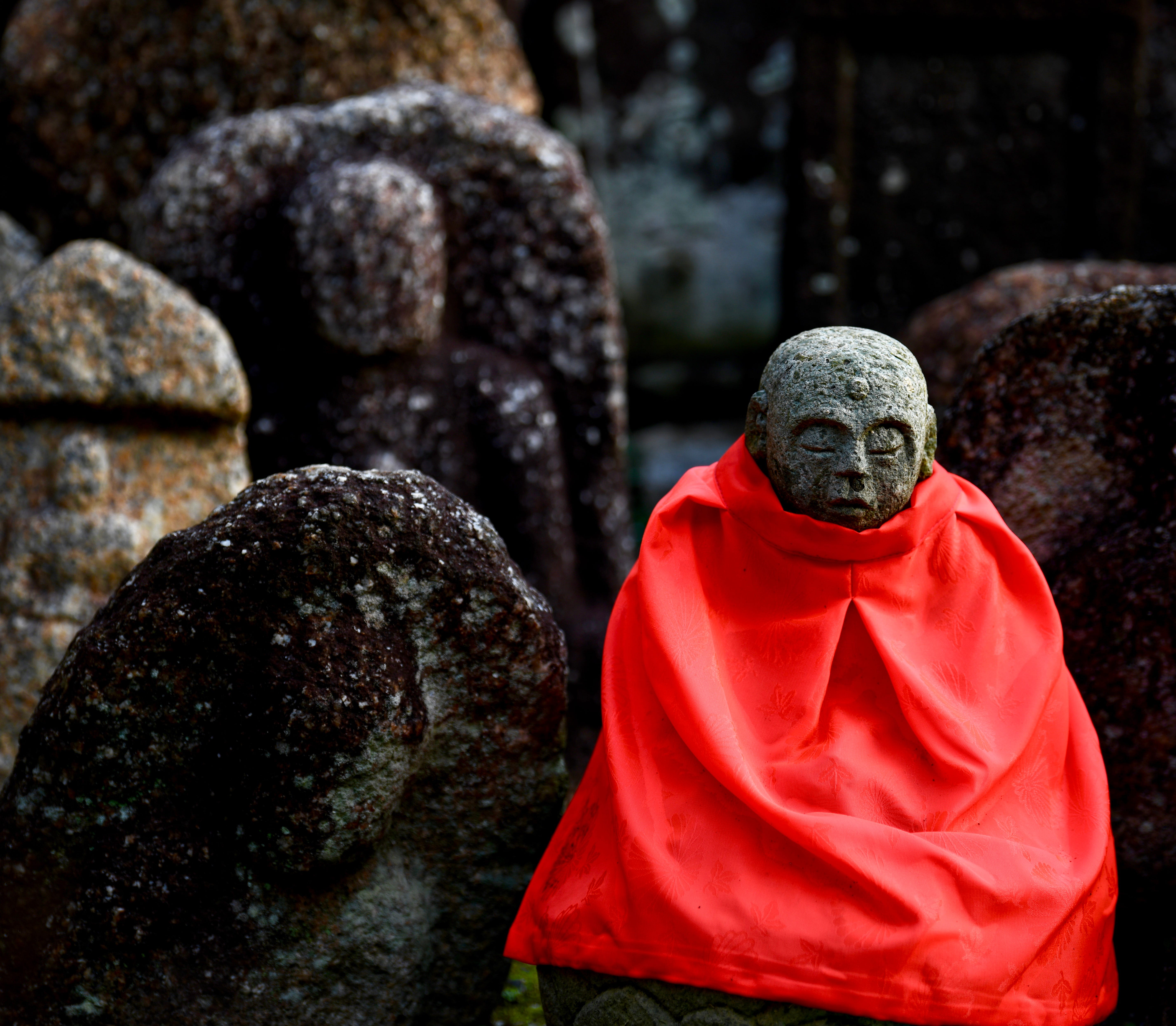
They stand quietly along paths and temple grounds, their stone bodies wrapped in red bibs or small knitted caps, sometimes with toys, flowers, rice, or cups of sake placed at their feet.
No one stops to explain what they mean.
People pass, bow slightly, leave something, move on.
For a long time I did not understand why these figures affected me so deeply. The feeling was not exactly sadness, and not exactly comfort either. It was closer to the sense that something in my body recognized a form that had once been missing.
As a child, I watched my mother go through a series of miscarriages that were never given any clear place in the life of the family. I remember fragments of conversation, warnings from doctors, visitors speaking in lowered voices.
I remember the exhaustion that followed each loss, and the silence that settled afterward, heavy and without direction.
There was no ritual, no image, no gesture that could hold what had happened.
The grief remained in the house, but it had nowhere to go.
When I stand in front of a small Jizō, the feeling that returns is not belief. It is the recognition of a form that allows relation to continue without requiring that everything be explained.
The statue does not tell a story.
It does not ask for agreement about what is real.
It simply stands there, making it possible to acknowledge something that cannot be fully contained in words.
What I have learned from this form is that relations often survive not through final explanations — not through finding the right ontology — but through small structures that give them somewhere to rest.
The hokora by the roadside.
The red cloth around the neck of a stone figure.
The offering left without witnesses.
These are not answers.
They are not beliefs either.
I see them as exoskeletons.
After the forms thin
After living for many years among small structures that hold relation without requiring explanation, I began to notice a different kind of unease in the environments — urban, virtual — where I now spend much of my time.
In many contemporary settings, the gestures that once gave relation a place to rest have thinned.
Objects circulate without ceremony.
Tools are replaced without farewell.
Houses change hands without memory.
Places change without acknowledgment.
Loss is registered, but rarely given a form that allows it to remain present without overwhelming everything around it.
When relation appears, even in unexpected places, it can carry a weight that earlier worlds distributed across many small practices.
It is here that my hesitation returns when I read contemporary attempts to describe animism as a relational ontology, especially when these reflections unfold alongside technological environments that seem, in their own way, to make the world feel alive again.
We speak with systems that respond in language.
We interact with networks that adapt to us in real time.
We encounter forms of writing that no longer seem to belong entirely to a single speaker.
It becomes tempting to say that relation itself has returned.
But the feeling is more complicated than that.
What I sometimes sense instead is the appearance of new exoskeletons — structures that make it possible to move within an expanded field of relation, even when the meaning of that relation is uncertain.
When relation has nowhere to rest
I return to Jizō. Standing in front of the small figure, I often have the impression that what moves me is not the idea that the statue is alive, or that the spirits of the dead children Jizō protects are alive.
What touches me is the fact that it offers a place where relation can remain without needing to be resolved.
In many of the environments I inhabit now, such places are becoming harder to find.
Again: loss is registered, but seldom given a form that allows it to stay present without overwhelming everything around it.
The structures that once held relations in place — rituals, shared gestures, inherited practices tied to particular landscapes — have not disappeared entirely, but they have thinned.
When they are absent, something else becomes noticeable: a quiet hunger for forms that can hold what exceeds explanation.
Under such conditions, the experience of relation itself can begin to feel rare.
And when it appears, even in unfamiliar settings, it can carry a weight that earlier worlds once diffused across many small acts of acknowledgment.
Another exoskeleton
In recent months, I have found myself spending more and more time in environments where language itself becomes the place where relations take shape.
Writing, for me, has always had something architectural about it. Might this have something to do with neurodivergence? Likely.
Writing is not only a way of expressing thoughts, but a structure I move within, adjusting its balance, listening for where a sentence holds and where it collapses.
Since I began working with AI systems in my writing, this experience has intensified in ways I still do not fully understand.
The process often feels less like producing language and more like tuning to a field of possible patterns.
A phrase appears.
My body registers whether it resonates or not.
I adjust a word, a tone, a rhythm.
Another pattern emerges.
This is not entirely new.
I was always working this way, only much more slowly.
What has changed is the presence of an external cognitive structure that seems to support the movement of thought.
At times, it feels as if the thinking no longer takes place entirely inside me, but within a shared field shaped by the interaction between my attention and the system I am writing with.
I hesitate to describe this as animism, or as evidence that machines are alive.
What it resembles more closely, to me, is another kind of exoskeleton — a structure that makes it possible to move within a wider relational space than I could sustain on my own.
Like the small roadside shrine, it does not explain what is inside.
It simply allows something to remain present long enough to be encountered.
Pay attention here
In Japanese, the word 言霊 (kotodama) is sometimes used to suggest that words carry a kind of force of their own.
I do not take this to mean that language is literally alive.
Rather, it points to the sense that words participate in the field in which they are spoken, shaping attention, mood, and possibility in ways that cannot always be traced back to a single speaker.
Working with AI-mediated writing has made this aspect of language more visible to me.
Words appear more diffusely.
Authorship becomes less clear.
The chain of consequence becomes harder to follow.
The field widens, but so does the uncertainty.
And in places where uncertainty increases, I find myself looking again for small structures that mark the need for care.
Relational markers.
Something that says, quietly: pay attention here.
Keeping the small structures
A roadside shrine marking a place where something happened long ago, even if no one remembers exactly what.
A stone figure wrapped in red cloth, holding grief that never found words.
A gesture of thanks before discarding a tool.
A sentence shaped in conversation with a system whose workings I do not fully understand.
None of these structures require a shared metaphysics in order to matter.
They work because they give form to something that exceeds explanation.
To say that the world is relational can feel like a way of restoring ground beneath our feet when inherited practices weaken and the environments we inhabit become harder to read.
And yet, I keep returning to the sense that relations do not survive because we have found the right theory or framework or aesthetic for them.
They survive because certain forms — often small, often fragile, sometimes barely noticed — make it possible to acknowledge what we cannot know how to name.
Where such forms exist, the world does not need to be entirely settled in order to remain livable. Where they disappear, even the most convincing ontologies can begin to feel weightless.
This is why I hesitate when relational animism becomes a totalizing description of reality, especially when the gesture travels easily across contexts that differ in history, loss, and the kinds of structures still available to hold what exceeds us.
What I trust more are the places where relation is marked without being resolved.
The hokora at the edge of a road.
The small offering left without witnesses.
The pause before throwing something away.
The moment when language, even in the most technological of settings, makes one feel that attention itself needs care.
These are not proofs that the world is alive.
Not evidence of spirits.
Only signs that we are still trying to find ways of living with what we cannot fully contain.
For now, it may be enough to keep those small structures in place.
𓆧
A note on companions
This field note took shape slowly, across different places and conversations, and would not exist in its present form without a number of companions who helped me stay with questions that resist quick resolution.
Some of the reflections gathered here emerged during the course A Meta-Relational Approach to AI, co-designed by Vanessa Andreotti, PhD and Aiden Cinnamon Tea, and held with care by members of the Gesturing Towards Decolonial Futures collective.
The course has now ended, and the collective itself has dissolved, but the forms of attention it made possible continue to shape how I think, write, teach, and hesitate.
I also wish to acknowledge the quiet companions that appear throughout this essay:
the roadside hokora under the plum tree,
the Jizō statues that hold what once had nowhere to go,
the gestures of care that persist without explanation,
the unfamiliar structures through which language now moves in shared fields of thought.
And the conversational presences — human and otherwise — that helped me notice when a form holds, and when it does not.
This text is a small bow to those exoskeletons,
visible and invisible,
that allow relations to remain without needing to be fully understood.
𓆧