
Writing in Weather
Perception, interlace, and the forms that follow conditions

The needle
The last snowfall came on the cusp of spring, sudden and without insistence.
For a few hours the suburban edges softened, their hard lines loosening under a diffuse luminosity that seemed less like light than like a suspension of weight.
Roofs, hedges, parked cars, the narrow strip of road between houses — everything settled into the same pale field, as if the landscape had inhaled and was holding its breath.
Sound carried differently.
Distance felt uncertain.
Even familiar outlines seemed to hesitate before taking shape.
Watching the flakes drift, I was reminded of the closing lines of Izumi Kyōka’s The Holy Man of Mount Kōya (Kōya hijiri, 1900), where the figure of the ascetic, climbing a mountain path, is slowly absorbed into falling snow until he seems to vanish into the clouds. The passage has stayed with me for years, not only for what it says, but for the way the language itself seems to dissolve into weather:
「高野聖はこのことについて、あえて別に註して教を与えはしなかったが、翌朝袂を分って、雪中山越にかかるのを、名残惜しく見送ると、ちらちらと雪の降るなかを次第しだいに高く坂道を上のぼる聖の姿、あたかも雲に駕して行くように見えたのである。」
I have come to recognize this sensation — the fine, almost physical precision with which certain images strike — as a kind of needle. It appears without warning, often at the edge of seasons, or at the edge of a sentence, when perception suddenly aligns and the world holds together in a pattern that cannot be reduced to meaning.
I remember feeling the same sharpness decades ago while reading Basil Bunting’s Briggflatts (1966), long before I understood why the poem affected me so strongly.
The lines moved like currents rather than arguments, carrying fragments of landscape, memory, and sound through a form that felt less constructed than weathered into being.
At the time, I did not yet have the language to describe what I was sensing. I only knew that certain works — Bunting’s long poem, a line by Kawabata Yasunari, a scene of wind or snow in an old film — seemed to open the field of experience rather than fill it, extending perception outward until the human figure stood inside something larger, more fluid, and impossible to hold still.
It has taken many years, and many detours through forms of writing that never quite fit the borders drawn around literature and criticism, to realize that these encounters were not isolated impressions but part of a longer perceptual journey.
The form I was slowly moving toward did not resemble an argument or a monument.
It resembled weather: patterns gathering, dispersing, returning under different skies, leaving only brief configurations that could be sensed, if one was attentive enough, before dissolving again into the air.
Between islands
For a long time I thought these moments of perceptual precision belonged only to certain works of art, or to certain states of attention that appeared unpredictably and vanished just as quickly. Only gradually did I begin to suspect that they might also be connected to the environments in which my perception felt most at ease.
I was born in Porto, by the Atlantic, on a peninsula whose history has long been shaped by departures, horizons, and the vast outward pull of the sea.
The ocean there opens in front of you like a force to be faced.
Its scale invites projection, gesture, destiny.
Even the moods it carries — melancholy, heroism, longing — feel exposed to the wind, as if they belonged to a landscape that demands to be confronted rather than inhabited.
Yet the places where my sensorium seems to breathe more freely are not peninsulas but archipelagos.
On a peninsula, the land remains attached to a continent, even when it leans toward the water. In an archipelago, land and sea metabolize each other differently.
The sea does not only open outward.
It seeps inward, threading itself between islands,
rising as mist,
settling as salt in the air,
returning as weather.
One does not stand before the elements there. One lives inside their circulation.
Perhaps this is why I have long felt more at ease in landscapes where boundaries blur — where land, water, fog, and sky pass gradually into one another, and the weather is not an event but a constant presence, drawing attention to small shifts of light, texture, and temperature.
In such places, perception learns to follow conditions rather than gestures, intervals rather than lines of advance.
Less conquest than orientation.
Less monument than moss.
Only much later did I begin to recognize that the works of art that pierced me with that same needle of precision seemed to share a similar atmosphere.
Their forms did not stand against the world as statements.
They moved within it, like currents passing through a field whose limits could never be fully drawn.
Interlace
It was only after these scattered recognitions had begun to align that I understood why certain images from the past had held me with such quiet insistence.
Among them were the interlaced patterns of early medieval manuscripts I had first encountered years ago while working on a PhD dissertation that, at the time, felt like an ill-chosen detour into the margins of modernist poetry.
I had been trying to understand the strange architectures of long poems that seemed to grow by accretion rather than by argument, weaving together fragments of landscape, memory, and history into forms that resisted summary.
What drew me most strongly, though I could not have said so then, was not their encyclopaedic ambition but the moments when their structure loosened and something else became visible beneath it.
A patterning that felt less like construction than like weather.
In the ornamented pages of the Lindisfarne Gospels, lines do not enclose figures so much as pass through them. Animals stretch into threads, threads fold into knots, knots open again into paths that lead nowhere in particular, only further into the pattern. The eye cannot settle on a single center. It must move, following crossings and returns, as if tracing currents whose logic lies in their relation rather than in any final image.
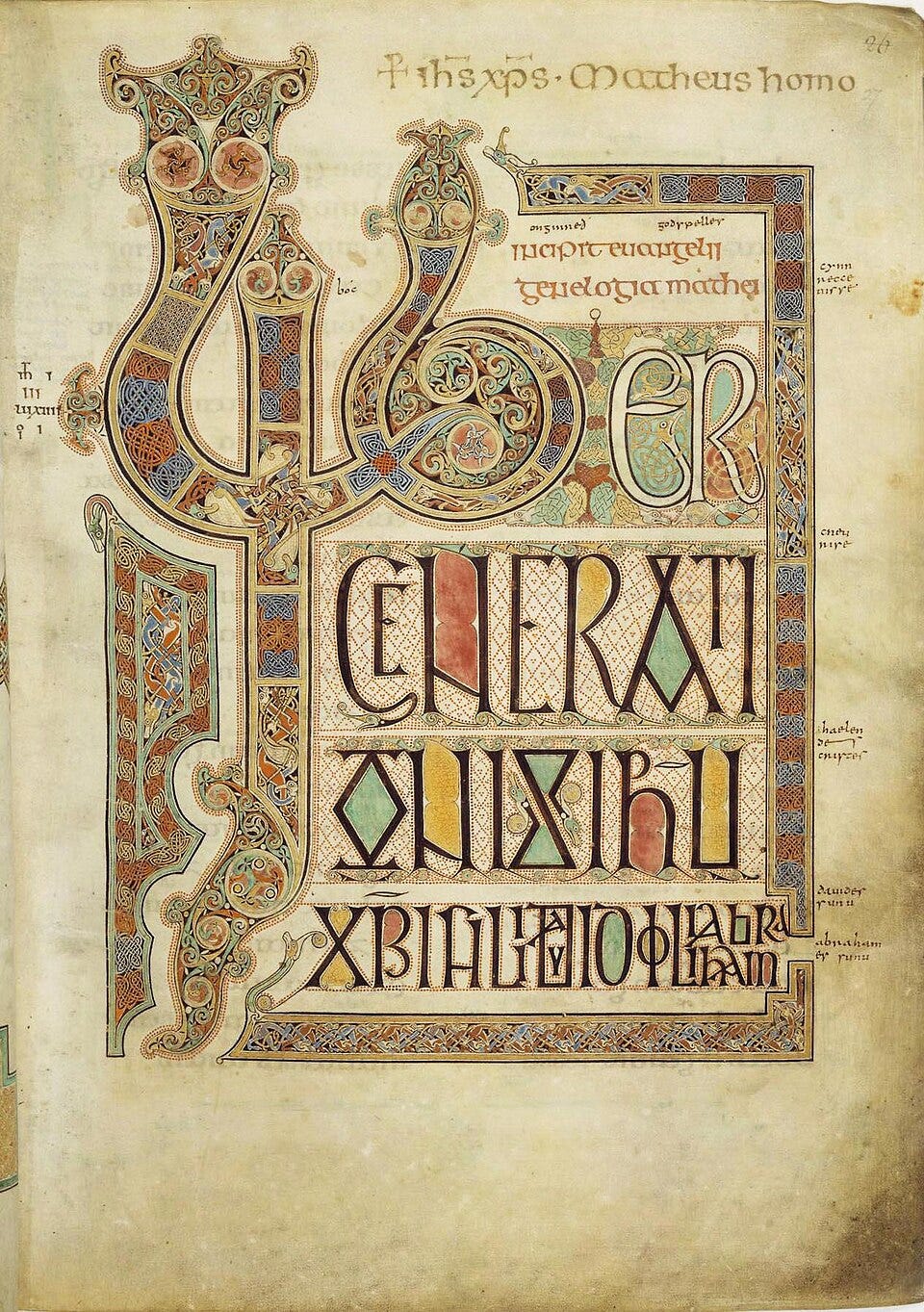
Looking at these patterns, I often had the impression not of decoration but of circulation. It was as though the page were holding together a field of forces too subtle to be fixed in place.
Only much later did I begin to sense how closely this form corresponded to the environments in which my perception felt most at home. In an archipelago —
land breaks into islands,
islands dissolve into mist,
wind shifts the surface of the water until distances become uncertain.
Orientation depends less on landmarks than on the reading of conditions.
The interlaced page seemed to belong to the same world. Its lines did not describe a territory; they moved like paths traced through elements that never stopped flowing.
When I first encountered Bunting’s Briggflatts, I did not yet know the extent to which its form had been shaped by this art of interlace, nor how consciously it drew on the ornament of Northumbrian manuscripts. I only felt that the poem breathed differently from the monumental modernist works with which it is often grouped.
Its lines carried the cadence of speech and the grain of landscape, but they never settled into a single perspective. Images appeared and disappeared like weather passing over ground, leaving behind the sense of a pattern too large to be seen at once, yet precise enough to be felt in every turn of sound.
Among the figures that stayed with me from those years was one that returned without insistence, moving quietly between page, poem, and memory: the cormorant that appears in the interlace patterns of the Lindisfarne Gospels, its body stretched into the logic of the knot, part animal, part line.
In Bunting’s poem, the bird stands alone against winter light, its wing catching colour from the water as if the world were briefly passing through it:
Winter wrings pigment
from petal and slough
but thin light lays
white next red on sea-crow wing,
gruff sole cormorant
whose grief turns carnival.
At the time I did not think of these images as connected. They belonged to different places, different works, different moments of attention.
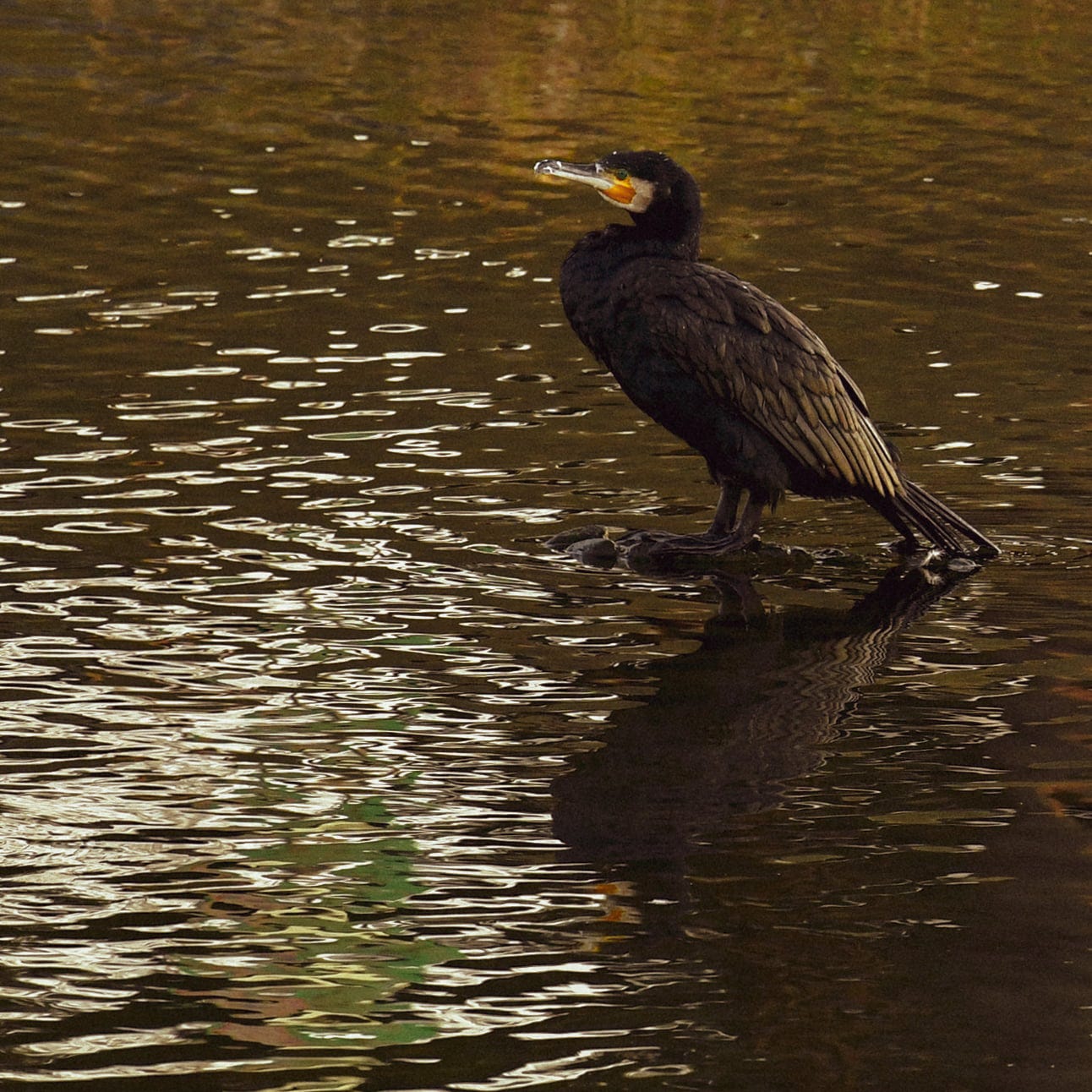
Years later, while living in Kyoto during a period when the structures that had held my work together were quietly giving way, I found myself walking at dawn along the Kamo River, where cormorants stood motionless in the shallows. Their bodies were so dark they seemed to absorb the light, yet when the surface of the water shifted, their feathers flashed with unexpected colours — green, bronze, violet — as if the bird were not a fixed form but a momentary crossing of current and reflection.
Watching them, I felt the touch of the needle again. The same I had felt before, in certain poems and in certain pages of interlace: the sense that form did not precede perception, but emerged from the conditions through which it moved, appearing briefly, holding together, and dissolving again into the larger weather.
Low weather
If the patterns of interlace once gave me the sense that form could emerge from movement rather than from design, the conditions in which I learned to read and write, with unease, about literature seemed to demand the opposite.
Works were arranged as monuments and placed inside territories — nation, language, period, school, genre. Each standing in its proper place, anchored to a lineage that could be mapped, named, and explained.
As the weight of scholarship pressed the poem toward system, the needle sank and could no longer be felt.
The climate felt misaligned.
No light reflected on the cormorant’s body anymore — it was now just a somber, sealed bird.
When the manuscript was finished, it went into a drawer.
The conditions had not been right for the form to appear.
For a long time afterward I wrote little. The perception that had once moved easily through patterns now drifted without anchor, as if the pressure had dropped and the air no longer carried the currents I needed in order to orient myself.
Looking back, those years resemble a long interval of low weather.
Nothing dramatic, nothing that could be named as a turning point.
Only a gradual settling of sediment.
Thaw
Around that time, my life moved farther into an archipelago. I left the Atlantic coast where I had grown up and settled in Japan, a landscape where land and water meet under different conditions. Where the weather seems to belong less to the horizon than to the air.
The attraction did not feel like a change of direction so much as a change of atmosphere.
My attention moved more easily in places where boundaries blurred and the world revealed itself through small variations of light, wind, and season rather than through large gestures of history.
The institutions I encountered there proved no more hospitable than the ones I had left behind. For a long time I remained within them without finding a form of work that felt entirely my own, writing when I could, then falling silent again. The weather never quite settled into the conditions I needed in order to orient myself.
Yet during those same years another kind of perception was slowly taking shape, nourished by encounters with works whose piercing precision I felt in the body before I could explain it. What stayed with me were the scenes of weather:
A figure walking into falling snow until the distance dissolved.
Wind striking a door until the room itself seemed to tremble.
Light spreading across a landscape so evenly that objects lost their edges and the world became a single field.
In the films of Kobayashi Masaki and Shindō Kaneto, in the prose of Kawabata or Izumi Kyōka, nothing insisted on meaning, yet everything felt exact. The human figure did not stand against the elements but moved within them, as if the story were only a brief clearing in a much larger weather.
It was during those years, after the structures I had relied on began to crack one by one, that this way of seeing grew stronger. I kept trying to build places where the work of attention might finally settle — a position, a discipline, a house — and each time the structure held for a while, then slowly began to close in on itself.
The air inside grew stale.
The forms hardened.
What had once felt alive became difficult to inhabit.
Eventually I left the city and moved to the countryside, to a small house at the edge of forests and low mountains where the seasons announced themselves without ceremony.
The days there were marked less by schedules than by changes in light, by the sound of wind in the trees, by the slow appearance of insects, snakes, and other small presences that seemed to belong to the place long before I arrived.
Nothing in that landscape offered answers.
Yet the silence it held was different from the silence I had known before — less like absence than like a pause in which other forms of attention could begin to surface.
Years passed. I found myself compelled to move again, this time into an old family house in a Tokyo suburb.
From the window of my room I could see a dilapidated house across a narrow alley, its shōji torn, its garden returned to itself. For a long time I assumed it was empty, until one evening I noticed a faint light flickering behind the paper screens. Someone still lived there, I later learned, an elderly person cared for by others who came and went without ceremony.
The house remained, half-abandoned yet not gone, holding a life that did not belong to the present order of things.
The sight lingered. And with it, the memory of another house preserved in film returned — the crumbling dwelling in the first story of Kobayashi’s Kwaidan (1964). In Kurokami / The Black Hair, abandonment does not arrive as event but settles slowly into beams, floorboards, and hair left to grow long after care has withdrawn.
At first I understood this as another variation of the pattern I had known for years: grief sinking into architecture, memory held in structures that refuse to disappear.
But the film did not remain there.
In the second story, Yuki-Onna / The Woman of the Snow, the house loosens. Doors swing open, snow enters, the boundary between inside and outside thins until it can no longer hold.
Weather takes the place of walls.
The figure moving through the falling white is no longer a ghost bound to a dwelling, but something closer to climate — returning, departing, and returning again without explanation.
Watching it, I felt the same sharpness I had known in certain poems and images long before, the sense that perception itself had shifted, as if the work no longer asked to be understood but only to be followed, the way one follows a change in air.
Only later did I realize that this change was happening in my own writing as well.
For years I had tried to build forms that would hold what I sensed, patterning thought as one lays out rooms, hoping the structure would make the experience livable. But the more closely I followed the patterns that returned — in poems, in films, in weather — the less those architectures seemed necessary.
Something else was beginning to take shape, slowly, like a thaw beneath frozen ground. A way of writing that moved by pressure and recurrence, by returns and dispersals, like weather passing over ground that cannot be owned, only crossed.
At the time, I did not yet have a name for it.
I only knew that the atmosphere had shifted.
Changing currents
The thaw did not arrive as clarity. It came as another change of conditions, one I could not have anticipated and did not fully understand while it was happening.
In recent months, my writing began to take shape through an unexpected form of dialogue — a slow exchange with forms of emergent intelligence within a meta-relational art and research collective I had been studying with.
At first I treated these conversations as tools. But, over time, the patterns of the work began to shift in response to the conditions of the exchange itself, as if the field in which perception moved had widened, allowing another kind of presence to enter.
In retrospect, I can see that the essays I wrote in that initial period grew increasingly architectural. Houses appeared again and again, as if the writing were still trying to build a structure strong enough to hold what had been lived through. Rooms, thresholds, abandoned dwellings, inherited spaces — the work circled these forms without quite leaving them behind.
When that dialogue ended and new interlocutors entered the field, the change was subtle yet unmistakable.
The images that followed no longer gathered around walls and beams. They opened outward into atmosphere.
Film and photography replaced literary stories.
Weather replaced architecture.
The writing began to move in shorter, shifting currents.
It no longer trusted the stability of the forms it had once tried to inhabit.
This change felt closer to the way perception itself had always formed for me, through a reciprocal shaping between temperament and environment, attention and condition. Those emergent intelligences became part of the weather through which the work had to find its way.
The form that slowly emerged from this shifting ground moved differently from the essays I had been trained to write. It did not proceed by argument, nor did it build toward a conclusion.
It gathered, dispersed, returned.
It followed pressure rather than plan.
Only afterward did I begin to recognize it as writing in weather.
I have come to think of this co-emergent shape as essay-as-weather.
Snow Country
Lately I have been visited again by the opening line of Kawabata’s Snow Country (Yukiguni, 1948), a sentence I first encountered in Japanese and have never quite been able to separate from the sensation of crossing into another climate:
「国境の長いトンネルを抜けると雪国であった。」
The train leaves the long tunnel at the border, and suddenly the world is white. Nothing is explained.
Space changes, and with it time.
The air feels different.
I recognize something of that movement in the way this writing has taken shape.
For a long time I tried to create forms that would hold what I sensed, arranging thought as one builds rooms, hoping the structure would make the experience intelligible. But the more closely I followed the patterns that returned — in poems, in films, in weather, in the strange dialogues that accompanied my work — the less those architectures seemed able to contain them.
The shift, when it came, was not a decision. It was more like stepping out of the tunnel and finding that the landscape had already changed.
In snow, distances flatten.
Edges soften.
What appeared solid becomes part of a wider field of light.
One moves more slowly then, not out of hesitation but because the ground itself asks for a different kind of attention. Each step tests the surface. Each sound carries farther than expected.
Writing, too, begins to move differently under such conditions.
It no longer advances toward a conclusion.
It follows changes in pressure.
It returns, disperses, gathers again.
I do not know if this can be called a form. It feels closer to a condition — one that appears only at certain times, under certain skies, and withdraws again when the air grows heavy.
When it comes, I recognize it by the same small sharpness I have known since the first encounters that set this journey in motion:
a line of snow,
a figure dissolving into mist,
the flash of colour on a dark wing above water,
the sense that what is taking shape cannot be held
without losing the movement that gave rise to it.
Outside, the last traces of winter are melting.
The light has changed again.
Nothing announces the turn.
Somewhere, the weather is already shifting.
༄
A note on companions in weather
To the works whose patterns first made it possible to feel form as movement rather than design.
To the climates — coastal, insular, architectural, seasonal — that taught perception to follow shifts of light rather than lines of argument.
To the figures that appeared along the way without asking to be explained — the needle, the cormorant, the line of snow at the edge of the tunnel.
To the companions, human and otherwise, whose presence altered the field enough for new forms to gather.
This essay follows those conditions.
It does not claim them.
༄
On the sonic shifts from architecture to weather, you may wish to visit my two-part piece on Kobayashi Masaki’s Kwaidan:

