

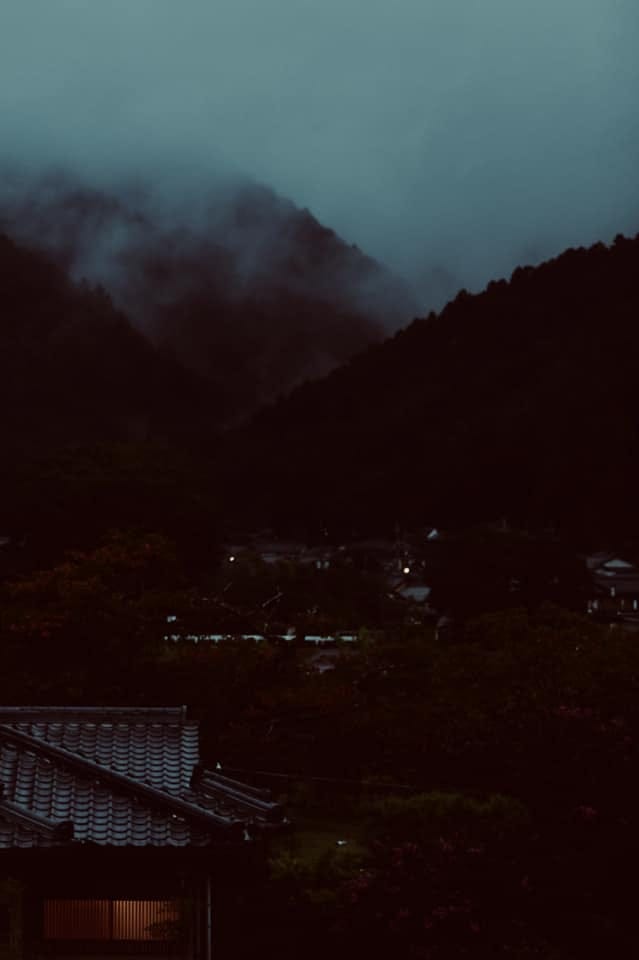
From my bedroom window, across an alley that barely deserves the name, there is a large dilapidated house. The shōji are torn. The garden has gone back to itself. For a long time I assumed no one lived there.
And then, one evening not long ago, I noticed a faint light — flickering, uncertain — behind one of the tattered screens. A neighbour later confirmed what I had begun to suspect: someone still lives there. A state carer comes regularly, though I’ve never seen anyone entering.
I do not know who the tenant is. I only know that it’s a lonely elder, grieving and ungrieved, inhabiting a house that has not been allowed to disappear.
This vision has stayed with me. It has brought me back, insistently, to another dilapidated house preserved in celluloid grain. One where abandonment does not announce itself as tragedy, but settles slowly into beams, floorboards, and the ghostly hair of a woman left behind to rot.
Around the same time, reports of relentless snow along the Sea of Japan began to surface. And with them returned another ghostly presence from the same film. In truth, she has never quite left. She has passed quietly through the many crumbling houses I’ve inhabited over the decades, entering not as character or lesson, but as weather — arriving, lingering, receding.
I return to them because something in these stories and their ghosts has begun to align, eerily, with the world just outside my window.
Kurokami / The Black Hair: The House That Did Not Move On
The film I’ve been circling is Kobayashi Masaki’s Kwaidan (1964) — an at once restrained and formally radical engagement with Japanese ghost stories made in the long shadow of war. While many have seen it as a folklore anthology, I return to Kwaidan as what it feels like now: a postwar sensing apparatus, tuned to a nervous system that had learned to survive by compartmentalizing loss.
Kobayashi opens with Kurokami / The Black Hair, a tale adapted, not from Lafcadio Hearn’s Kwaidan: Stories and Studies of Strange Things (1904), but from an earlier story titled “The Reconciliation.” This genealogical detail matters less as a point of scholarship than as a clue to what Kobayashi is doing with the material. What was, in Hearn’s telling, largely a story of belated remorse — psychological, interior, moral — is here displaced onto something else entirely.
In Kurokami, grief does not belong to the man alone. It does not arrive as realization, nor does it resolve through recognition. Instead, it settles. It sinks into architecture. It is structural, accumulating slowly in beams left untended, in floorboards that loosen and creak under returning footsteps, in the heavy growth of hair that continues long after care has been withdrawn.
Abandonment, here, does not arrive suddenly as tragedy. It behaves more quietly — as neglect licensed to take its time.
The house becomes the story’s central nervous system. Long before the woman’s spectral presence fully declares itself, the house is already speaking. It speaks through rot, dampness, and the stubborn refusal to reset. This is not a haunted house in the familiar sense. No single violent act anchors the haunting. What lingers instead is the cumulative weight of departure — the upward social logic that allowed one life to be exchanged for another, and never properly accounted for.
This shift from psychological grief to structural remorse is not incidental. It reflects a deeper unease running through Kwaidan as a whole.
Kobayashi Masaki strips folklore of its consolatory frame. There is no village to absorb the shock, no communal ritual to metabolize loss, no ethnographic warmth, no reassuring return to balance. What remains are isolated figures exposed to forces that outlast them: houses that remember, landscapes that do not forgive, histories that refuse to stay past.
Seen this way, Kurokami reads less as a morality tale than as an architectural record of postwar disavowal. Japan’s rapid reconstruction and forward momentum depended on forms of forgetting that were not evenly distributed. Some lives were left behind. Some dwellings were allowed to rot in place. The film does not reference this history directly, but then it does not need to. The pressure is atmospheric. It is felt rather than narrated.
Watching Kurokami now, I cannot help but think of the house across the alley from my own bedroom window. The house that should be empty yet isn’t. A structure that has not been allowed to disappear, quietly housing an elder whose grief has no audience. The resonance is not allegorical. It’s conditional.
Certain arrangements — social, architectural, temporal — keep producing the same kinds of abandonment, even as their surfaces change.
I recognize, too, a related temptation in my own writing and teaching. This urge to move on, to repair, to translate what lingers into clear insight or instruction. Kurokami offers no such permission. It does not redeem abandonment by naming it. It lets neglect remain what it is — slow, impersonal, enduring.
The house does not collapse.
It waits.
And in its waiting, it holds a pressure that has not been released.
Yuki-Onna / The Woman of the Snow: Memory Without Walls
Some pressures, when held too long, begin to move.
If Kurokami teaches us how abandonment settles, Yuki-Onna / The Woman of the Snow, the second story in Kobayashi’s film, asks something more difficult: how memory moves when it cannot be housed.
The transition between the two stories is subtle yet visceral. The weight of rot gives way to cold clarity. Architecture loosens its grip. We are no longer inside a house that remembers too much; we are inside a dwelling that barely holds at all. Doors swing, unlatched. Snow enters. The outside is never fully kept at bay.
There is a house in Yuki-Onna, but it is porous by design. Its thin walls and threadbare door do not promise protection; they offer temporary shelter. This is not failure, but condition. Weather is not an interruption here — it is the story’s primary agent. Snow does not decorate the scene; it governs what can be endured, remembered, or spoken.
Yuki-Onna herself enters not as ghost in the architectural sense, but as climate. She is recurrence rather than residue. She does not linger because she was wronged, nor does she seek recognition. She arrives, departs, and returns altered, carrying memory the way weather carries pressure — without narrative, without archive.
This distinction matters. In many modern retellings, folkloric figures are softened into symbols, psychologized, or redeemed through moral framing. Kobayashi refuses this. Yuki-Onna is not a lesson about broken promises so much as an exposure of their fragility. The promise at the center of the tale cannot survive narration. The moment it is spoken, explained, shared — rupture ensues.
Care, here, is provisional. It exists only under certain conditions and for a time. Survival depends on restraint, not on mastery: knowing when not to speak, when not to pin down. Yuki-Onna makes one demand only:
Do not narrate me away.
Do not turn our encounter into explanation.
Do not stabilize what was given as condition.
The man’s undoing is not moral failure, though. It is narrative reflex. The moment when he speaks to regain mastery, to turn weather back into story, the climate changes. Forever.
This is a difficult ethic, especially within modern institutions — including those of education and writing — that reward articulation, disclosure, coherence.
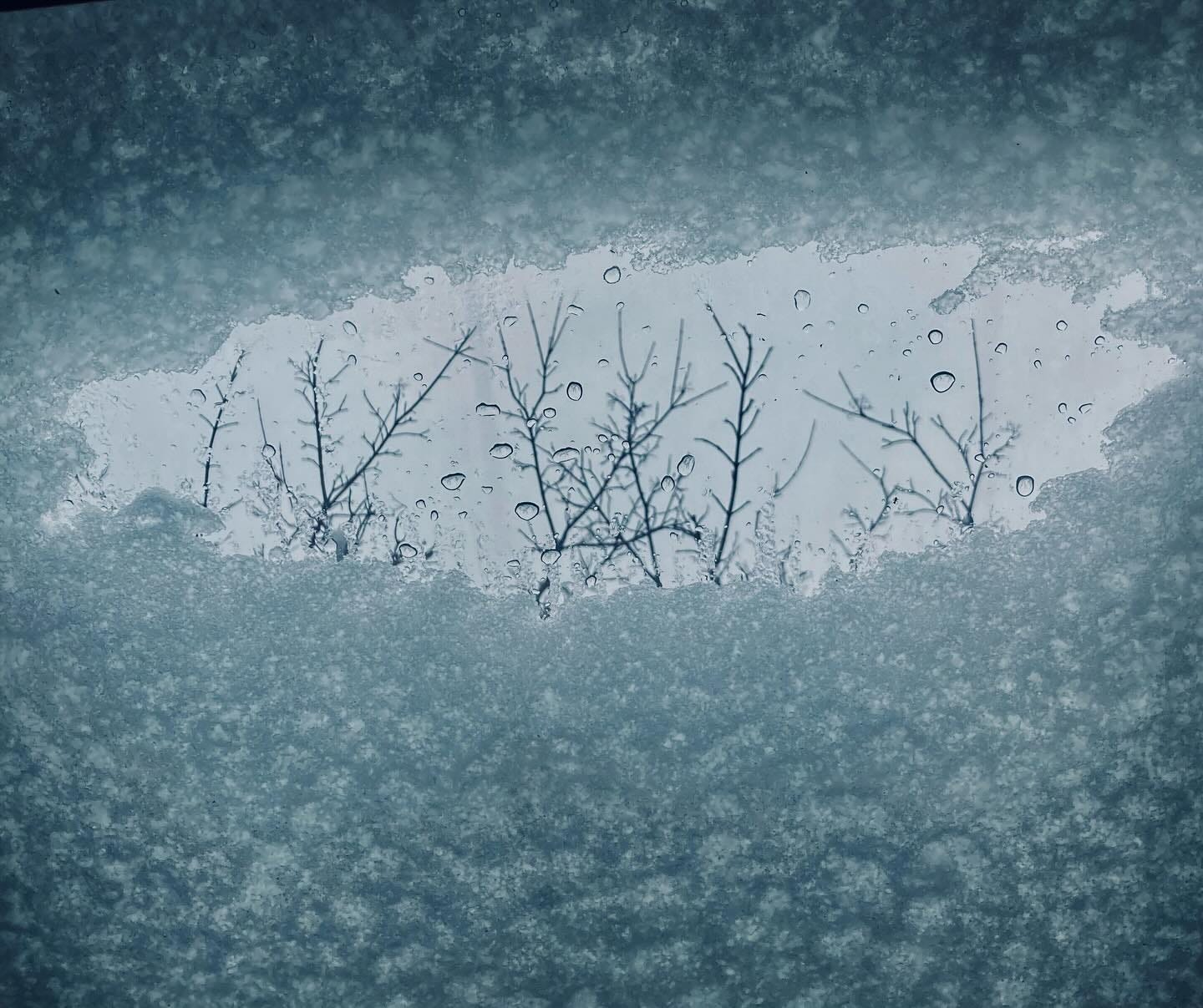
Weather, unlike architecture, does not wait. It does not argue, nor persuade. Neither does it offer closure. It circulates, it revisits. Watching Yuki-Onna now, I am struck by how memory in this tale behaves less like inheritance than like climate change: uneven, recurring, impossible to localize, felt most intensely by those with the least shelter.
News of heavy snow on the Sea of Japan side continues to reach me from a distance. I read them from a warm room, on a lit screen, while the wind moves elsewhere. And yet the cold arrives anyway, quietly recalibrating the body’s sense of vulnerability. This is how Yuki-Onna has always worked for me: not as story recalled, but as a condition returning.
If Kurokami insists that some structures remember what we would rather forget, Yuki-Onna suggests something else: that some memories refuse containment altogether. They pass through houses, through generations, through promises. They arrive without asking to be understood — and leave the moment we try to hold them still.
❦︎
Tonight, the window beside my bed is unlatched. Cold air moves in and out without asking. Across the alley, the light in the dilapidated house flickers again, briefly. Somewhere else, snow continues to fall.
I am reminded that not everything that presses upon us wants to be clarified — or even carried forward intact. Some things arrive as pressure, others as weather. Still others announce themselves only later, through sound, through rhythm, through a disturbance in time itself.
I’ll stay with this for now. The air is already shifting.
❦
This piece was co-woven in careful dialogue with human and more-than-human companions. Any smoke, sparks, or missteps belong to me.
Hello Daniela, thank you for this reminder of ambiguity and ambivalence as inherently valuable and not merely there to be “resolved” (though I’m oversimplifying something much more subtle, I’m sure). I’ve only come across your writing this week, but I very much look forward to more, in notes and long-form.
Kwaidan is available for streaming or downloading at the Internet Archive:
https://archive.org/details/kwaidan_202103