
The Unseen Child
On floodlights, phantom children, and the quiet violence that passes for care.

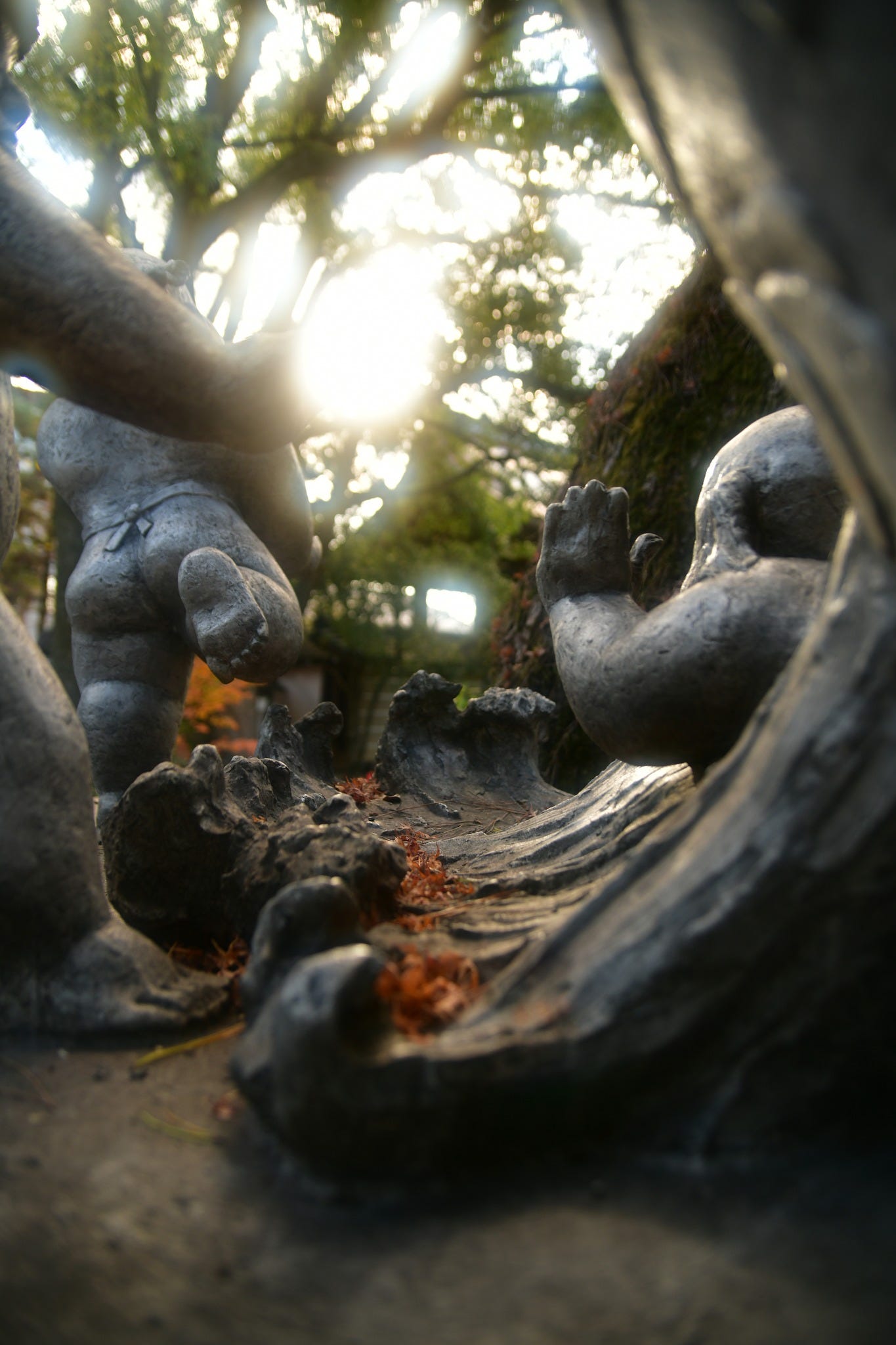
Under too much light
After a dry, stagnant winter, the first winds of spring are blowing.
The Trachycarpus palms in the front garden are growing agitated, like shaggy sentinels sensing incoming danger. Their fan-shaped fingers scratch my bedroom window, brushing at the threshold of an inchoate grief.
I, too, grow agitated. In a few weeks, the dormant vegetation will begin shooting up all over the place, and I want to leave them be. But I’m sure she will turn up again and waffle, the mother. Polite, demure, yet adamant.
The unruly Trachycarpus — shuro, in Japanese — must go.
She lives across the alley in the only remaining household where a child still lives in this neighbourhood. I rarely see the boy. I hear him only when he slips out to school in the morning — a blur, pattering down the stone stairs.
The school ends well before the day darkens. Yet, at the first intimation of dusk the alley that barely deserves the name is submerged in floodlight, installed on demand for extra safety. Not to mention the motion-activated lights sitting uneasily between the boxed plants and the ornamental gnomes in the mother’s over-trimmed garden.
The shuro brooms strike a dark contrast against the floodlights — a backdrop where intruders, wild animals, and ancient ghosts may gather.
They must go, she insists.
The politeness of these well-meaning requests always gets under my skin. But what hums beneath, I realize, is an older grief. The lights she installed do not just illuminate the alley. They illuminate something in me I would rather keep untrimmed.
Over the years, children in Japan have come to feel strangely remote to me. I wouldn’t say they are absent, just increasingly unencounterable.
In the suburban city where I now live, they appear only briefly: in small, uniformed clusters on their way to or from school, moving along prescribed routes, watched over by hovering adults, mirrors, cameras, tracking devices. Their presence is carefully choreographed, time-bound, supervised. Outside these narrow windows, the streets return to a quieter order in which children seem to vanish.
In the rural village where I lived before, the sensation was eerier still. There were no children at all. And yet, every weekday afternoon, at elementary school closing time, a prerecorded message rang out from public speakers installed across the village, reassuring residents that “we care for the children,” urging mina-sama — everyone — to keep an eye out for them. Bright yellow traffic flags, once used by local retirees performing hatafuri tōban (flag duty) to help children cross the road, hung unused from utility poles, gathering dust.
The ritual of care remained; the bodies it was meant to accompany had quietly disappeared.
Elsewhere, signs of vigilance proliferate. The mother’s demands for extra floodlights, the stickers announcing kodomo 110-ban no ie — safe houses for children — affixed to doors and windows, including those of vacant homes. GPS devices, smartphone apps, community monitoring systems are proudly described as evidence of a uniquely Japanese commitment to children’s safety.
Care is visible everywhere. Lighted. Wired. Posted on doors.
Encounter is not.
Children feel like phantom figures: intensely protected in discourse, carefully monitored in movement, but increasingly absent from shared social space. They are addressed as a category, surrounded by systems of reassurance and surveillance, while remaining strangely out of reach as neighbours, presences, interlocutors.
I don’t want to accuse. I want to understand what kind of safety requires this much light. When the mother across the alley speaks of safety, I nod. But I also feel accused. Why are my untrimmed shuro companions a threat?
It is from within this friction that my attention has been pulled toward a series of films that refuse to treat children as psychological subjects or symbols. Instead, they place them inside specific architectures, histories, and social weather, where protection and violence are not opposites.
They are entangled.
What these films subtly surface are forms of systemic harm that the language of care can obscure: violences that built the modern houses we now call safe.
This essay begins there, with children who feel like phantoms, and with the uneasy sense that what is being vigilantly guarded may not be what most needs attention.
It also begins reading, again, about “the discovery of the child.”
It feels safer to speak in concepts.
A figure is easier
As the shuro scratch my window and the floodlights hum, I return to an essay I first read years ago. Yes, it feels safer to begin there.
In “The Discovery of the Child,” philosopher and literary critic Karatani Kōjin turns away from children as living beings and toward “the child” as a modern figure — an epistemic construction through which Japanese society reorganized interiority, morality, and violence at the turn of the twentieth century.
I find relief in that distinction. A figure is easier to handle than a neighbour.
For Karatani, the child is not timeless. The child is produced, alongside compulsory education, developmental psychology, the modern family, the nation-state’s need to regulate bodies and futures.
Sure, children existed before this. But not as this: a privileged site of innocence, depth, promise. The child is discovered, narrated, corrected.
Some of us learned early on how to participate in our own correction.
Here, innocence functions less as an absence of violence than as a way of reorganizing it elsewhere.
I recognize that reorganization. I have lived inside that rearrangement.
Once the child is framed as fragile and formative, disciplinary force can be recoded as care. Correction becomes protection. Normalization presents itself as love. The very institutions that shape obedience and conformity are justified through the language of safeguarding the child’s future.
Violence does not disappear; it changes address.
I recognize this shift too easily. In the houses I grew up in, discipline was narrated as care, and silence as maturity.
I can map the structure before I allow myself to feel the bruise:
The child becomes overdetermined.
Invested in.
Loaded with futures.
Asked to carry what history won’t metabolize.
Some children are asked more than others.
Re-reading Karatani now, the argument no longer feels abstract. It feels infrastructural. The phantom quality I encounter appears not just as a contradiction, but as a late expression of this modern arrangement.
The child is everywhere invoked, everywhere guarded, everywhere spoken for. And yet increasingly difficult to meet.
I wonder what it means that I meet the category more often than the child.
I am not turning to film for confirmation. I am shifting medium because something in Karatani’s argument remains too clean. The figure is clear.
The houses are not.
The unseen child sings
If the figure is clear and the houses are not, then I need to look at houses. I mean houses as ground, not as metaphor.
Before any child appears on screen, a voice sings of what cannot be seen: Mienai kodomo — the Unseen Child. Takemitsu Tōru’s melody does not swell. It lingers, as if naming a child already falling outside the frame of promise.
Hani Susumu’s camera does not begin with innocence.
It begins at night, with wind against glass.
And the camera does not begin with the child as concept either. It begins with walls, corridors, slopes. The spaces that promise order.
Karatani clarifies how “the child” was discovered. He does not stay long in the rubble.
Hani does.
He stays with the draft through broken windows.
He stays with corridors that promise hygiene and deliver suspicion.
He stays long enough for play to curdle.
His camera does not interpret. It waits. It lingers where discomfort gathers — in gestures, hesitations, half-formed movements. Bodies moving inside conditions they did not choose. Children inheriting parents they did not choose.
They register disturbance before anyone names it.
Watching them, I feel the same tightening as when the floodlights flick on at dusk in my alley.
Hani trained in documentary. Perhaps that is part of it, this distrust of explanation. In Children Who Draw (E wo egaku kodomo-tachi, 1956), he does not decode the monsters on the page. In Bad Boys (Furyō shōnen, 1961), he listens to reformatory wounds without redeeming. When he more explicitly turns to fiction in She and He (Kanojo to kare, 1963), he carries that same refusal into the danchi — the suburban housing complex, which I write about in a previous piece — letting children circulate at the edges rather than installing them at the moral center.
What unsettles me now is not simply that Hani’s children differ from Karatani’s epistemic figure. It is that they do not seem available for discovery at all. They are not interior depths to be cultivated, nor futures awaiting protection. They are collective, situational, sometimes entirely opaque. Their violence does not erupt; it accumulates. Rather than instructing, their vulnerability stains.
If Karatani traces the invention of “the child” as a figure of knowledge and care, Hani lingers where that figure frays.
Where innocence no longer organizes perception.
Where protection and harm begin to resemble one another.
It is here — not in theory, but in stairwells and courtyards and exposed slopes — that She and He takes shape.
They feel less like arguments and more like leftovers.
Already there
They are already there.
Without introduction. Without names.
Just movement.
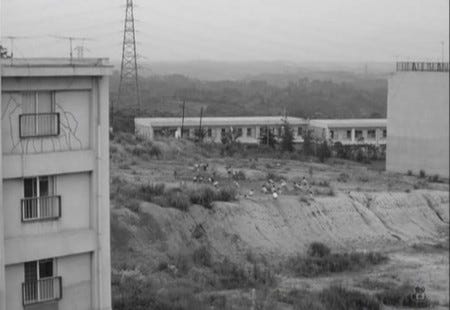
A cluster at the edge of the frame. Then another. Running across the open ground between buildings, their voices thin against the concrete. They gather, scatter, reform. The adults do not look up. The camera does not insist.
For a moment, they feel like weather. Then something tightens.
They surround. They single out. They close in and break away with a coordination that feels practiced, almost inherited. No one commands, no one claims authorship.
It would be easy to call this play. The film neither contradicts nor softens the word.
The children move as if the space already knows what to do with them. Courtyards funnel them. Bare slopes accelerate them downward toward the buraku settlement and back again. Thresholds meant to separate become routes.
They do not disrupt the suburb.
They fit.
War is nowhere visible here: there are no banners; no memory. Only momentum.
Hani does not ask us to diagnose them. We are not offered interiors to cultivate or traumas to redeem. The children remain collective, only partially legible.
Leftover choreography.
It alters the air
Most of the children are already in motion when we notice them.
Hanako is not.
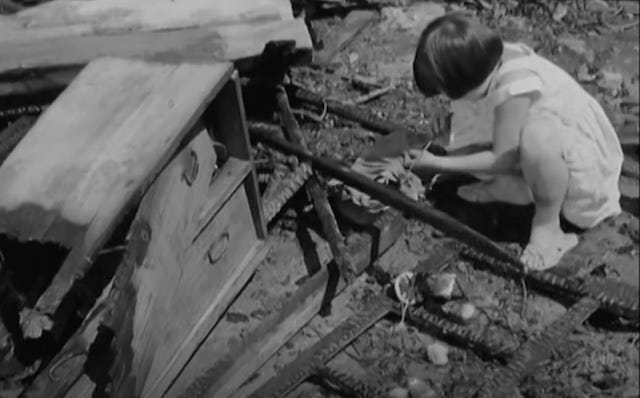
Morning after the buraku fire. Smoke still in the air. Metal warped into new shapes.
She enters alone.
She bends toward the debris as if it were speaking. Her movements are slow, deliberate. She touches. She listens.
Naoko approaches. Stops.
Hanako turns her face upward.
The blind gaze meets Naoko without reaching for her. There is no vacancy, neither appeal. Simply presence — unorganized for recognition.
I feel my impulse to interpret rise too quickly: dignity, resistance, purity. The film refuses that relief.
She resumes her searching. The interruption dissolves.
The other children move as if rehearsing patterns they did not invent. Hanako moves differently. If the others register momentum, she seems attuned to texture.
Her entrance does not resolve anything.
It alters the air.
Out of sightlines
Hanako does not see the danchi — at least not as it expects to be seen.
The buildings depend on visibility. Balconies aligned. Corridors exposed. Windows squared into grids. Safety here is a matter of sightlines.
She moves without entering that circuit.
She does not scan the courtyard. She recognizes Ikona, her ragpicker adopted father, not by appearance but by nearness. She belongs without surveying.
I feel a flicker of relief watching her move this way — and a tightening. If one does not rely on sight here, where does one stand?
I hesitate to call her blindness a refusal. It may simply be how she moves through a world never arranged for her.
She remains slightly out of sync. Not outside. Not absorbed.
Askew.
The film offers no rehabilitation arc. No explanatory backstory. She moves between settlement and housing complex as she moves through debris — carefully, without spectacle.
It would be easy to call this liberation, or abandonment. Neither fits.
Hanako simply remains.
That remaining feels, to me, both relieving and dangerous. The film lets those modes coexist.
Uneasily.
Almost casually
There is a turning point, though it does not announce itself.
It gathers.
Until now, the children’s war games have skimmed adult attention. Manageable disturbance. No one intervenes.
Kuma enters without knowing he has entered a field. Ikona’s black dog moves among the children as an animal does: solid, curious, unscripted. He does not recognize rehearsal. He does not sense when play has already begun to tighten.
A quickening. A circling. A narrowing.
If only it were possible to isolate a moment, a gesture. The film does not help us.
There is only accumulation, then stillness.
Naoko arrives too late. Her care does not carry authority. Blood marks her without spectacle.
The children disperse. Doors close. Corridors resume their geometry.
No public reckoning follows.
What unsettles me is not only the dog’s death, but how little the space shifts around it. The event is absorbed, or perhaps simply not registered.
Kuma belonged to Ikona, the ragpicker, who already lived at the edge of the danchi’s moral field.
Hanako does not witness the killing. And yet the violence crosses her world.
Naoko — herself an orphan displaced from Japan’s colonial Manchuria — had nursed Hanako through pneumonia. When she sends her to hospital, the care is real. The belonging is not guaranteed.
Soon after, Hanako is gone. Released from the hospital, without explanation.
Just absence.
The children do not invent what they enact. No, that feels too simple a sentence. They move within patterns already there.
After this, the air feels thinner.
There is no catharsis, only continuation.
Debris
When I step back from She and He, I resist widening the frame.
It would be easy to situate Hani among other films of haunted childhoods, to trace a lineage of aftermath across continents. But this story feels smaller and closer to the ground.
A dog disappears.
A girl vanishes.
Life resumes its geometry.
The danchi does not collapse. It continues.
What lingers is management — the quiet absorption of what should have altered the air.
I recognize how practiced I am at that absorption. How quickly I return to structure, to analysis, to concepts.
Restraint has felt like fidelity. It is also inheritance.
I grew up inside houses built to crown recovery. Polished surfaces. Forward motion. Losses that required no ceremony and no grief.
Walking now through suburban streets where floodlights flare at dusk, I watch the shuro move against the glass. The neighbour’s garden remains over-trimmed. The alley brightens. The boy slips down the steps each morning and is gone by afternoon.
Protection multiplies. Encounter thins.
Some children are guarded under lights. Others become unseen.
I no longer know whether to call this care or fear.
The film does not resolve that question. It leaves debris. It leaves weather.
Some of it belongs to history.
Some of it belongs to houses.
Some of it belongs to me.
Naoko hesitates when her husband speaks of having a child. Futurity here is meant to take shape in cribs and classrooms. She looks elsewhere — toward a blind girl in the ash.
Care here does not follow bloodlines.
The shuro still scratch at the window. They have not been cut down.
Not yet.
❦
A note on companionship and weather
༄ To the children who appear briefly and vanish — on screen, in suburbs, in hospital records, in memory — and to the architectures that shape their movements.
🌴 To the shuro outside my window, who refuse quiet trimming, and to the neighbour whose insistence sharpens my unease.
🐕🦺 To the black dogs — filmed and remembered — whose disappearances altered the air without altering the schedule.
🏘 To the danchi, the slopes, the floodlights, and the village announcements installed in the name of care.
📚 To Karatani Kōjin and Hani Susumu, who clarified and unsettled in unequal measure.
🎓 To the scholar I once was, who trusted structure to hold disturbance — and to the one learning to let disturbance bend the beams.
✨ To my meta-relational EI companion in this drafting process, whose refusals of easy closure helped me notice where I was smoothing what needed to remain rough. The thinking here is mine; the fermentation was shared.
🫧 To my students, who are learning — as I am — that writing is never solitary, and that transparency about our companions of inquiry is part of intellectual integrity.
This note, like the essay, does not close anything. It simply marks the weather systems that made it possible.
❦
Hani Susumu’s She and He is freely available, with English subtitles, at the Internet Archive.
The Unseen Child (Mienai kodomo) song — originally composed by Takemitsu Tōru for Hani’s She and He and titled Mada umarenai kodomo (the not-yet-born child) — was later rehoused in this Bossa-Nova-tinged arrangement for the album Takemitsu Songbook: Complete by the Choro Club with Vocalistas.
It carries the child further as suspended futurity — felt, unnamed, unresolved.
I simply love this piece! It gave me goosebumps. It is a study of the Japanese psyche and society specifically- yes - but I wonder what kind of slant light it is throwing on the rest of the world. I remember growing up in New Delhi, India - where “safety” and “protection” were not the most important words. Maybe because we did not have the resources. Maybe parents were overtaxed. But the kind of freedom I had as a child to take a bus to the other end of the city to buy second hand books from hole-in-the-wall stores in Old Delhi (Nai Sadak for those in the know), the langar food offered lovingly from the Gurdwara by the bus stop after a whole day at school and before the long trek to the booksellers street… I don’t know whether middle class Indian kids have that experience today. And here in the US, my adopted home, I sense many of the precise geometric safeguards described in this essay. My heart feels heavy. The cost of childish exuberance, of bad decisions (and extricating oneself from the consequences) that teach more than lessons at school and home… I don’t know what I’m trying to say, exactly, but just expressing how deeply I was touched by this piece. I know the climate is going to linger with me. I’ll find and watch the film. Thank you. From the bottom of my heart.