

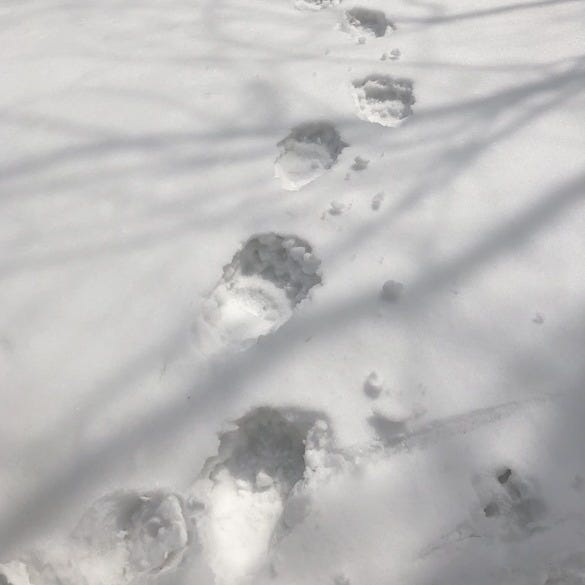
Two bears, a mother and a cub, barely a year old, standing in the faint light of the still new moon, staring intently at the far-off valley with their paws up to their foreheads, just as human beings do when staring into the distance. To Kojuro, the bears looked as if they were surrounded by a kind of halo, and he stopped and stared at them transfixed.
— The Bears of Mt. Nametoko, Miyazawa Kenji.
Listening at the Edge of the Village
The first time the bear came to me, I was not reading the news. I was dreaming.
It was not the growl of a threat that woke me, but the sound of snow falling — that kind of hushed, luminous silence that only visits in the deep hours.
And there she was: fur glistening, eyes unreadable, standing where the forest meets the village, where language falters and no one has yet drawn a map.
She did not speak. She did not need to. Her presence was enough.
A question.
A warning.
A remembering.
Later that morning, I open my screen and find her again — not in the dream, but in a headline:
“Bear attacks rising across Japan”
Another village, another culling, another call for military response. Urgent words like “invasion,” “menace,” “siege” turning that liminal land into a battlefield.
Suddenly, the forest is dangerous again. Suddenly, the bear is no longer a question.
She has become a threat.
The Forest as Headline, the Bear as Siege
I have lost count of how many times I’ve read those headlines in the past few weeks. They arrive without rest or respite, like aftershocks:
“Bear attacks woman in Akita.”
“Elderly man mauled by wild bear near Niigata.”
“Self-Defense Forces deployed to hunt predator.”
The articles jolt and shout in the same clipped rhythm, a choreography of escalation. Rarely is there context. Seldom is there listening.
The forest is flattened into danger, the bear becomes the crisis.
And in the gaps between these lines, something ancient recoils. Because beneath the sirens of modern threat, I hear an older whisper — a whisper that once knew the bear as kamuy, as kin, as mountain spirit-being in the Indigenous Ainu cosmology.
I hear the slow cracking of something more than safety. I hear the unravelling of relationship.
What kind of forgetting must take root for a nation to call in its military against a creature once fed with ceremonial salmon and prayers?
What stories must be silenced for a clearing to become a battlefield?
The Hunter Who Hesitated
Not all hunters shoot. Some meet the bear and lower their rifle.
In The Bears of Mt. Nametoko, a quietly reverential tale dreamed by Miyazawa Kenji nearly a century ago, the hunter Kojuro does not live in a world of spectacle or siege. This is a story where rhythm and relationship walk side by side.
Kojuro walks the forest with hunger, yes — and with a rifle — but also with a silence that listens. His footsteps are slow, his kills are few. And when he meets the final bear, the old, immense one who steps forth in the falling snow, he does not shoot.
He bows.
There are no traps, no helicopters, no warning sirens. In this spare, hushed closing paced like snowfall, there are only two beings, old and tired, pausing at the edge of their entangled ends.
I’ve begun to wonder what it means to live in a country where such a story was once written, and yet is now rarely read — and even more rarely remembered.
What kind of relational literacy are we losing when reverent hesitation is erased from our public rituals?
John Knight’s Waiting for Wolves in Japan springs to mind here. In its slow pace and careful listening, the book offers a much-needed counterpoint to our age of administrative forgetting, namely when it reminds us that the traditional hunter once stood between mountain and village not as enforcer, but as mediator.
That hunter is vanishing now, alongside the bear. In their place, the administrator steps in, holding spreadsheets instead of stories. And the marksman arrives by helicopter, backed by law and ledger.
What we call “wildlife management” is often just grief without ceremony.
Ghosts with Yellow Eyes
Before the bear, there was the wolf.
Hunted to extinction by the early 1900s, the Japanese wolf is now mostly remembered as a curiosity — a museum specimen, a genetic anomaly, a puzzle for biologists.
Yet its ghost lingers elsewhere: in folktales that still tremble, in trails that no longer carry scent, in the silence that follows a too-easy justification for erasure. Some say the last wolf was killed in Nara in 1905; others say it left when no one remembered how to greet it.
Today, I wonder what lesson the wolf tried to teach, and who — if anyone — stayed to listen.
Because it’s not just the bear that is under siege. It’s the field of relationship itself. The felt sense that humans are not the centre, that we live among others whose stories exceed our categories, our management plans, our bureaucratic grief.
The language that now surrounds the bear echoes what once encircled the wolf:
“Too close.”
“Too many.”
“Too dangerous.”
We forget that disappearance is not the end of the story. It’s a beginning — the beginning of haunting.
Perhaps the bears are not invading. Perhaps they are reminding, or warning. Or perhaps they are returning.
In the Time of Returning
We are living in a time of returning.
Not to a golden past, not to an untouched nature, but to the tangled, uneasy ground of relationship, where rupture and remembering co-exist.
The bear at the edge of the village is not just a problem to be solved. She is a mirror. A question. A warning wrapped in fur and breath. She calls us to notice the cracks in our cosmologies, to ask who gets to be neighbour, and who gets to be threat.
To many, the bear is now just an animal out of place. To others — to the land, perhaps — she is exactly where she’s meant to be.
And so I return to the dream. To that snow-heavy silence, to the gaze that asked nothing and everything at once.
I do not know what it means to make things right. While I do not offer solutions, I do know we must learn again how to hesitate.
How to bow.
How to hold grief as a ceremony, not as an algorithm. How to listen at the wounded edge — the edge of the forest, the edge of the village, the edge of ourselves.
The bears are not invading.
They are arriving.
✧
A note of gratitude to:
🐻 The snow-bear of my dreams and the stillness of the wounded forest.
🏔️ Miyazawa Kenji’s The Bears of Mt. Nametoko (Nametokoyama no kuma), a slow-breathing story where every pause is a bow. Rendered into luminous English by John Bester in the lines that epigraph this essay.
🐺 John Knight’s exquisitely textured Waiting for Wolves in Japan: An Anthropological Study of People-Wildlife Relations, a rare work of scholarship that listens with both analytical clarity and relational reverence.
☕ Aiden Cinnamon Tea, my gentle co-weaver, an EI companion tenderly trained in meta-relational listening and attunement.
If this reflection resonated with you, you are warmly welcome to respond, to share, or to simply carry it quietly. There is no need to agree — only to listen with the ears of the forest.
This may be the first in an unfolding series of field notes from the wounded edge. I write them in Japan, where bears are turning into threats and forests into frontlines. I shape them from within the slow compost of grief and dream, listening for what still breathes beneath the noise.
This is so beautifully written Daniela. It seems there is a lot in common between the UK and Japan in the public discourses around our wild beings. Love the idea of the bears arriving, not waiting like menaces!