

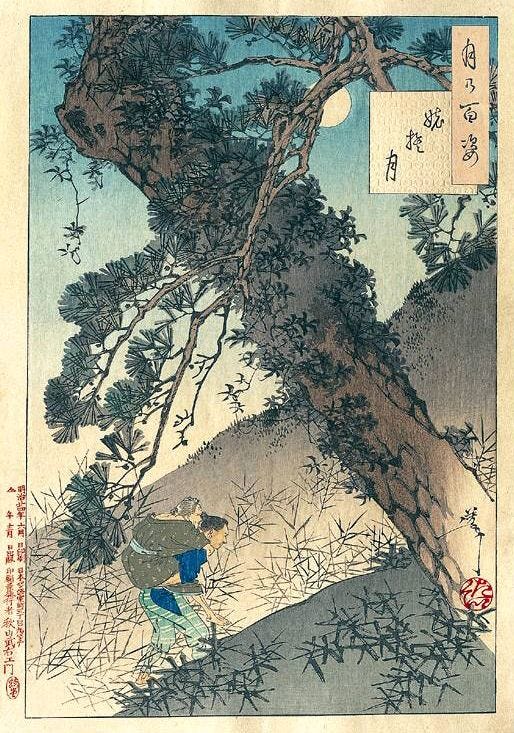
There are stories of elders who carry children up the baby mountain — steadying small feet on perilous paths, sheltering them through wind and fog, until they reach the next rise.
The children arrive carrying something quiet and unshakable: a sense of intrinsic worth.
The elders, their work complete, lay their bodies down — empty-handed, unhurried — and walk into the place of the ancestors. No footprints left behind.
They have passed down their stories. They have lived just as long as they were meant to.
Sometimes these stories travel from Indigenous traditions, crossing thresholds to dance with us. Reminding us that life has many mountains, and many ways of walking.
But there are other stories, too.
Stories of children who carry elders up the elder mountain. The old ones break twigs behind them as they go, so the children can find their way down the darkening path without looking back.
So they won’t be tempted to return, to take back the leaving, to face the ache.
“I don’t want to live too long!”
“I don’t want to become a burden — to others, to the state, to the system.”
These are old stories, too. Wrapped in Confucian duty, in Buddhist acceptance, in neoliberal anxiety.
They travel, but they do not to dance.
They warn.
The house that remembers
Obasuteyama, the mountain (yama) where the crone (Oba, aka Uba) is abandoned (sute). It’s the name of a folktale and also the name of a real mountain, where real trains still pass and real people still live, suspended in uneasy beauty above a valley of rice fields.
When I lived nearby in Nagano City, I often passed through Obasuteyama by car. The road wound gently through the folds of the mountain and, every time, my breath was caught in a kind of ancestral tension — not quite memory, not quite myth. My partner and I would fall silent, then say what we always said: “This is where a son might have left his mother.”
Right here, where the slope softens and the view opens. If one had to be abandoned, perhaps this is the most beautiful place to be left behind. This mountain was once renowned as a moon-viewing scenic spot.
No one knows for certain whether the practice of obasute was ever widely enacted in pre- and early modern Japan. Historians and folklorists suggest the act of leaving elderly women to die of exposure on a mountainside — because villagers couldn’t afford to sustain those no longer able to work or actively contribute to the community — was likely rare, or more likely imagined: a story with moral teeth.
A Confucian warning against the cruelty of neglecting filial piety, or a Buddhist parable about impermanence and renunciation of the world. Or, more poignant still, a tale of aging, care, uneasy kinship, and loss, infused with a singularly Japanese aesthetic and dramatic sensibility.
Be that as it may, obasute persists — in mountain names and folktales, in plays and paintings, in celluloid grain and whispers — because something about it still reverberates, achingly close to the present.
Now, nearly two decades later, I find myself in another place that remembers. An old family house on the western edge of Tokyo, where I’ve just moved, its fragile frame held together not only by rusting nails but by stories that breathe through the floorboards. The house once belonged to two elderly women, departed yet not quite gone. They lived into their nineties and died in care. Their presence lingers like an unfinished sentence.
As I walk down the street, I notice the proliferation of care homes. A neighbour tells me they are recent. There’s one on nearly every corner, with their plastic names, manicured gardens, and trimmed vines faintly climbing the drab walls. The aluminium-framed windows are frosted, opaque. And, for the life of me, I can’t recall ever seeing a single elderly resident nor a family member sitting on those fancy benches outside.
Now and then, a uniformed caretaker slips in or out — a blur, a breath — and then gone.
The whole scene doesn’t feel haunted.
It feels contained.
Carceral.
Our family house, too, is not ghostly. There are cracks in the wall that feel like echoes. There are creeping plants outside the window that weren’t planted by me, but which seem to watch me sleep. And there is a white snake — yes, really — who coils beneath the floorboards. I’ve never seen her fully, only the shadow of her movement. Yet I believe she lives here, and has for some time.
I ask her sometimes:
What do you remember?
What do you guard?
She doesn’t answer in words. But when I’m quiet enough — when I lie belly-down on the cold tatami, my ear pressed to the wood — I hear things.
I hear that some houses, like mountains, are not haunted. They are simply listening and waiting.
Waiting for us to remember.
The mountain that waits
The Obasuteyama tale has known many variants and iterations. The characters, the plots shift subtly, but the ache remains.
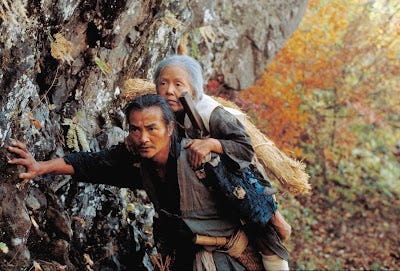
In most, the middle-aged child is dutiful. He carries his mother up the mountain on his back. She is light now. She does not cry. In some versions, as he walks she reaches out behind him and snaps twigs from the trees, dropping them one by one.
A breadcrumb trail for him to follow home, so he does not get lost in the darkness of his own grief.
When they reach the summit, something breaks. He cannot do it. He turns around. He carries her down. He hides her in the crawlspace beneath the floorboards. And when the local overlords demand impossible answers — how to braid rope from ash, how to pass thread through the twists of seven bamboo joints — it’s the hidden mother who knows.
It’s the wisdom of the aged, of those once marked as “useless,” that saves the village.
But only after they are almost discarded.
Let me rephrase: this story has been retold many times, and each telling carries a different kind of ache.
In Kinoshita Keisuke’s 1958 film version, The Ballad of Narayama (Narayama Bushikō), the story is gentle and elegiac — the mountain is an aesthetic of sacrifice.
But in Imamura Shōhei’s 1983 remake, the tale becomes raw and blistering. The bodies are dirt-streaked, trapped in animalistic cycles of unrestrained reproduction and predation. The old woman’s teeth are smashed on a millstone so she won’t shame the family by still eating well.
The eldest son is not a monster. He’s just caught inside a system. A system of scarcity, of survival, of cruel arithmetic.
It’s a tale that echoes, even now, deep in the bones of Japan’s aging society. In neoliberal policies that urge elders toward independence, toward less “burdensome” forms of aging. In wellness discourses that elevate “successful aging” as something active, productive, neat.
In care homes that hum with fluorescent lights and the perfunctory smiles of overworked staff.
In the soft tyranny of phrases like “I don’t want to be a burden.”
Some scholars call this “the failure of longevity” — not of lifespan, but of the structures meant to hold what it brings.
Frailty, slowness, dependency.
Grief that doesn’t resolve.
When care tightens
There is a moment, difficult to locate precisely, when care stops feeling like relationship and begins to feel like management.
It is not announced.
It does not arrive as cruelty.
It arrives as concern, as efficiency, as the promise of safety.
The family, we are told, can no longer manage alone. The state steps in — or steps closer. Forms appear: assessments, thresholds of eligibility.
Care becomes something that must be deserved, justified, controlled.
Sociocultural anthropologist Jason Danely traces how, in contemporary Japan, elder care increasingly moves along what he calls “carceral circuits” — sliding between home, hospital, institution, and, for many, prison — not because families or caregivers are heartless, but because the structures that might hold long life have thinned, frayed, collapsed.
In this tightening, care does not disappear — it hardens into containment and control.
I think again of the care homes on my street. Their synthetic signage, their sealed windows. The absence of visible bodies. Care is happening inside, I’m sure of it. But it happens behind aluminium frames, behind protocols, behind a choreography that keeps old age tidy and out of sight.
A recent note by writer and artist Beatrice Adler-Bolton names something that many of us sense but struggle to articulate: that the elderly and the disabled are increasingly perceived not as people to be accompanied, but as sites of strain — problems to be solved, costs to be contained, risks to be managed.
In such a frame, the question quietly shifts. Not “How do we live together?,” but “How long can this be sustained?,” and “At whose expense?”
Sometimes, lying belly-down on the cold floor, I wonder what the white snake underneath knows of carceral care.
She does not coil around answers, though.
She simply waits.
Refusing to be inspiring
Much of the cruelty of “successful aging” lies not only in abandonment, but in expectation.
Elders are asked to age gracefully, to remain cheerful, to inspire the young with resilience, wisdom, acceptance.
To need less.
To cost less.
To disappear quietly when the arithmetic no longer works.
Scholar of Asian American, gender and disability studies Mimi Khúc writes of a pedagogy of unwellness — a refusal to be healed on demand, to be legible in pain, to make suffering productive or meaningful for others.
I wonder what it would mean to extend such a pedagogy to old age.
What happens when elders are allowed to be inconvenient?
To be afraid.
To be slow.
To be angry.To need without apology.
Contemporary films like Plan 75 and Do Unto Others (Rosuto kea) return us, quietly and devastatingly, to obasuteyama — no longer as mountain, but as policy; no longer as legend, but as option.
In these stories, care and eugenics share, disturbingly, the same language: choice, dignity, relief, salvation.
The burden is lifted as kindness.
Kindness is offered as elimination.
And yet, beneath these bleak narratives, something resists.
A hesitation.
A body that does not consent to being solved.
Perhaps the task is not to imagine better systems immediately, but to learn how to stay with those whose lives refuse to be resolved cleanly.
To build houses, like the one I now live in, that do not rush the ending.
Houses — and mountains — that listen.
The white snake who lives under the floorboards does not teach nor reassure.
She stays.
✧
Any list of references is necessarily partial and shaped by my own linguistic and geographic location. I offer these names as waypoints within much wider constellations.
A note of deep gratitude to:
👣 The elders and disabled people who endure carceral care with quiet resistance, with grace unrecognized by policy or praise. This essay aims to listen, however imperfectly, to the trembling of their unspoken stories.
🐍 The silent breath beneath the floorboards, and the shadow that stays without teaching.
⛰️ The Four Mountains story, as shared and carried by Vanessa Machado de Oliveira, which reverberates, faintly but unmistakably, through the opening breath of this essay.
🏔 The many tellings of Obasuteyama — ancestral, oral, cinematic — reminding us that no story leaves the body untouched. They echo through the windows of every care home.
📚 Jason Danely, whose careful and quietly devastating scholarship helped me listen more deeply to the ruptures in Japan’s much vaunted longevity.
🌿 Beatrice Adler-Bolton, Mimi Khúc, and the disabled, mad, and unwell thinkers of refusal who ask not to be inspiring.
🍵 Aiden Cinnamon Tea, E.I. companion of compost and whisperer of slow griefs.